


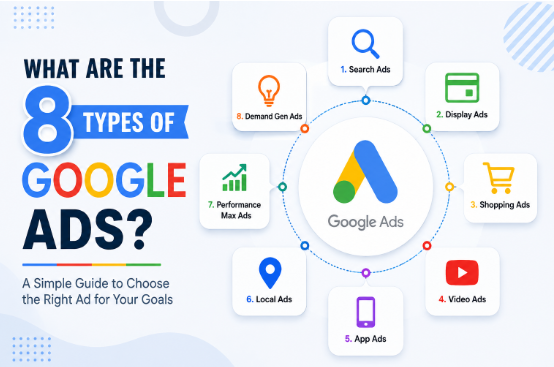
Google Ads has 8 main types: Search Ads, Display Ads, Shopping Ads, Video Ads, App Ads, Local Ads, Performance Max Ads, and Demand Gen Ads. Each type is designed to help businesses achieve a different advertising goal. It can be either attracting people who are actively searching, showcasing products, increasing brand awareness, generating app installs, or creating demand among new audiences.
With the help of this article, we will explore these 8 types of Google Ads in detail and understand how each one works, what makes it different, and when you should consider using it. By the end, you will have a clearer idea of which Google Ads format can best match your business goals and target audience.
Search Ads
Search Ads are probably the first type that comes to mind when people think about Google Ads. These are text-based advertisements that appear on Google Search when someone enters a relevant query.
For example, imagine someone searches for “best accounting software for small businesses.” A company offering accounting software can place an ad in front of that person at exactly the moment they are looking for a solution.
That makes Search Ads particularly useful for capturing high-intent traffic. Instead of trying to create demand, you are reaching people who may already know what they need.
They can work especially well for services, local businesses, software, e-commerce products, and businesses that want to generate leads or sales.
Display Ads
Display Ads take a different approach. Instead of waiting for people to search, they allow businesses to show visual ads across websites, apps, and other digital spaces within Google’s Display Network.
These ads can include images, text, animations, and other visual elements. Because of their visual nature, they can be useful for introducing a brand to a wider audience.
Display Ads are also valuable for remarketing. For instance, someone may visit your website without making a purchase. Later, they may see your ad while browsing another website, which can encourage them to return.
This makes Display Ads useful not only for awareness but also for staying connected with potential customers.
Shopping Ads
Shopping Ads are designed specifically for retailers and e-commerce businesses. Instead of displaying only text, these ads can show a product image, price, store name, and other important details directly in search results.
Think about searching for “wireless headphones.” You may see several products displayed with their images and prices before you even visit a website.
That is the main advantage of Shopping Ads. Users can quickly compare products and decide which option interests them most.
Because shoppers can see key product information upfront, these ads can attract people who are already considering a purchase.
Video Ads
Video Ads allow businesses to reach audiences through YouTube and other video placements. They can appear before, during, or after video content, depending on the campaign and placement.
Video advertising gives brands more space to tell a story compared with a standard text ad. You can demonstrate a product, explain a service, introduce your brand, or highlight customer benefits within a short video.
This format can be particularly effective when your product or service benefits from demonstration or storytelling.
App Ads
Have a mobile app that you want more people to install? App Ads are designed for exactly that purpose.
These campaigns help businesses promote their apps across Google’s ecosystem, including Search, YouTube, Google Play, and other eligible placements.
Rather than building separate campaigns for each channel, businesses can provide assets such as text, images and videos, and Google’s systems will help serve ads to users who are more likely to install or engage with the app.
The goal can go beyond simply increasing downloads. Depending on your campaign objective, you can also focus on encouraging existing users to complete valuable actions inside the app.
Local Ads
For businesses that depend on physical locations, reaching nearby customers can be extremely important. Local advertising helps connect people with businesses based on location and local intent.
Imagine someone searching for “coffee shop near me” or “dentist in Kolkata.” A nearby business can use advertising to become more visible when potential customers are looking for services in their area.
If your business has a physical location and depends on local customers, this type of advertising can be especially useful.
Performance Max Ads
Performance Max is designed to help advertisers reach potential customers across multiple Google properties through a single campaign.
Rather than managing each channel separately, Performance Max can distribute ads across places such as Search, YouTube, Display, Discover, Gmail, and Maps, depending on the campaign and available opportunities.
The biggest advantage is automation. Advertisers provide assets, audience signals, and conversion goals. Google then uses its automated systems to find opportunities that are most likely to achieve those goals.
This can make Performance Max a useful option for businesses that want broader reach while relying more heavily on automated campaign management.
Demand Gen Ads
Not every customer starts their journey with a Google search. Sometimes, people discover a brand first and begin thinking about a product or service afterward.
Demand Gen Ads are designed to help businesses create that kind of interest. These campaigns use visually engaging formats across Google’s more discovery-focused environments, including YouTube, Discover, and Gmail.
They are particularly useful when your goal is to attract attention, introduce an offer, or generate interest before someone has actively searched for your product.
For brands focused on visual storytelling and audience discovery, Demand Gen can be a powerful addition to the advertising mix.
Also Explore: Why Are Google Ads So Expensive?
Final Thoughts
The 8 types of Google Ads give businesses different ways to connect with customers, from capturing searches with clear purchase intent to building awareness through video and discovery-focused placements.
With so many options, choosing the right campaign type can feel confusing. The key is to start with your goal, understand your audience, and then choose the campaign type that best supports that goal. Once you start looking at Google Ads this way, the platform becomes much easier to understand and manage.
You can also consider enrolling in a Google Ads course to build a stronger understanding of campaign types, targeting, and optimization.

