


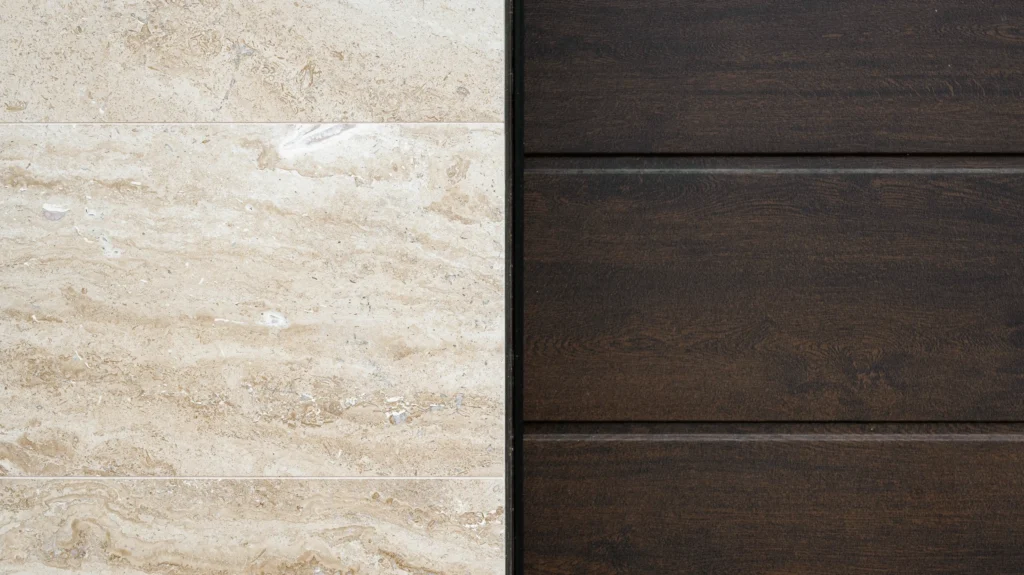
Choosing the right tile requires more than comparing colours and designs. Flooring and wall surfaces must also meet practical requirements such as durability, water resistance, maintenance, installation, and long-term performance. Porcelain and vitrified tiles are two popular choices for residential, commercial, hospitality, and architectural projects, but buyers often wonder how they differ.
The confusion partly comes from the manufacturing process. Porcelain tiles are highly dense ceramic products, while vitrified tile is a broader term commonly used for tiles manufactured through a vitrification process. Both categories can offer low porosity, attractive designs, and strong performance, but their exact characteristics depend on the product specification.
For homeowners, architects, builders, importers, and distributors, understanding these differences can make tile selection easier. Instead of focusing only on product names, buyers should examine technical specifications, intended applications, design requirements, installation conditions, and total project costs.
What are Porcelain Tiles?
Porcelain tiles are dense ceramic tiles manufactured from carefully selected raw materials and fired at high temperatures. The manufacturing process produces a compact body with very low water absorption.
Modern porcelain tiles are available in many styles and formats. Manufacturers can create surfaces inspired by:
- Natural marble
- Granite
- Limestone
- Travertine
- Wood
- Concrete
- Natural stone
Large-format porcelain tiles have also become popular because they can create broad surfaces with fewer visible grout joints.
Their combination of low porosity, design flexibility, and durability makes them suitable for many residential and commercial applications when the correct product is selected.
What are Vitrified Tiles?
Vitrified tiles are produced through a manufacturing process that transforms the tile body into a dense, glass-like structure. The process reduces porosity and creates a hard surface suitable for various applications.
The vitrified tile category includes different product types, such as:
- Glazed vitrified tiles
- Polished vitrified tiles
- Double-charge vitrified tiles
- Full-body vitrified tiles
- Large-format vitrified tiles
Each type can provide different visual and technical characteristics. Therefore, buyers should evaluate the specific product rather than assuming that all vitrified tiles perform in exactly the same way.
Porcelain vs Vitrified Tiles Comparison
| Comparison Factor | Porcelain Tiles | Vitrified Tiles |
| Product Category | A specific type of dense ceramic tile | A broader category of tiles made through vitrification |
| Manufacturing | Uses refined materials and high-temperature firing | Uses a vitrification process to create a dense tile body |
| Water Absorption | Generally very low | Generally low, depending on product type |
| Density | Highly dense | Dense, with characteristics varying by category |
| Durability | Strong when correctly selected and installed | Strong when the product matches the application |
| Design Range | Marble, stone, wood, concrete, and decorative effects | Wide range of colours, patterns, finishes, and formats |
| Maintenance | Generally easy with suitable cleaning | Generally easy with suitable cleaning |
| Residential Use | Floors, walls, bathrooms, kitchens, and selected outdoor areas | Floors, walls, kitchens, bathrooms, and commercial spaces |
| Commercial Use | Suitable products available for many commercial applications | Many options available for commercial applications |
| Outdoor Use | Selected products can suit outdoor conditions | Depends on technical specifications |
| Selection Method | Compare technical data and intended use | Compare product type, technical data, and intended use |
This comparison demonstrates why buyers should avoid making decisions based solely on terminology. Product specifications provide a more useful basis for selection.
How Do Porcelain and Vitrified Tiles Differ in Water Absorption?
Water absorption is an important consideration when selecting tiles for moisture-prone areas.
Porcelain tiles generally have very low water absorption because their dense structure limits the amount of moisture that can penetrate the tile body. This characteristic makes suitable porcelain products useful for bathrooms, kitchens, and other areas where moisture may be present.
Vitrified tiles also generally have low water absorption, but performance varies according to the particular product type and manufacturing specification.
Buyers should therefore review technical documentation before choosing tiles for wet areas instead of relying only on general category descriptions.
Which Offers Better Durability?
Both porcelain and vitrified tiles can provide excellent durability when manufacturers design them for the intended application, and installers follow appropriate installation practices.
Actual performance depends on:
- Tile composition
- Manufacturing quality
- Thickness
- Surface finish
- Breaking strength
- Traffic level
- Installation quality
- Maintenance
A tile selected for a low-traffic residential room may have different requirements from one used in a busy commercial environment.
Therefore, buyers should match the product’s technical characteristics with the expected level of use.
How Do Their Designs Compare?
Both tile categories provide extensive design possibilities.
Porcelain Designs
Porcelain tiles can reproduce natural materials with detailed patterns and tonal variation. Marble-look surfaces can create a sophisticated appearance, while wood-look designs can add warmth to residential interiors.
Concrete and stone-inspired porcelain tiles also work well with minimalist and contemporary architecture.
Vitrified Designs
Vitrified tiles offer a broad selection of colours, patterns, finishes, and formats. Glazed vitrified products can provide decorative surfaces, while polished options can create a bright and refined appearance.
This variety means buyers can find suitable designs across different budgets and interior styles.
What Should Buyers Know About Installation?
Even a high-quality tile can perform poorly if installers use unsuitable methods.
- Prepare the Substrate: The substrate should be stable, clean, and sufficiently level for the selected tile format.
- Select Suitable Adhesive: The adhesive should match the tile, substrate, and intended application.
- Plan the Layout: A proper layout reduces unnecessary cuts and helps maintain balanced joints across the installation.
- Handle Tiles Carefully: Dense tiles can require suitable cutting tools and careful handling, particularly when using large formats.
Professional installation can help reduce issues such as lippage, uneven joints, weak bonding, and cracking.
How Does Export Sourcing Affect Tile Selection?
International buyers face additional considerations when purchasing porcelain or vitrified tiles. Export sourcing involves more than selecting a design from a catalogue. Buyers must evaluate product specifications, packaging, shipment requirements, documentation, delivery schedules, and total landed cost.
A reliable export supplier should provide clear information about:
- Product dimensions
- Technical specifications
- Available finishes
- Packing details
- Minimum order quantities
- Production timelines
- Shipment arrangements
- Required documentation
For international procurement, working with an experienced vitrified tiles exporter can help buyers coordinate product selection and export requirements more efficiently. Buyers should also request samples before placing large orders. This allows them to assess colour, surface finish, texture, shade variation, and overall appearance under actual lighting conditions.
How Should Buyers Choose Between Porcelain and Vitrified Tiles?
There is no single product category that suits every project. Buyers should evaluate the complete requirements before making a decision.
- Consider the Application: Identify whether the tile will be used in a living room, kitchen, bathroom, commercial floor, wall, lobby, or outdoor area.
- Review Technical Specifications: Check water absorption, strength, dimensions, thickness, finish, and application suitability.
- Compare Designs: Look at colour, pattern, texture, format, and how the tile will interact with furniture, lighting, and other materials.
- Consider Installation: Large and dense tiles may require specific installation methods and suitable equipment.
- Calculate Total Cost: Include tile price, waste, installation, transportation, taxes, duties, and other applicable costs.
- Check Supplier Support: Reliable suppliers should provide clear product information, samples, packaging details, and order coordination.
Frequently Asked Questions
Are porcelain and vitrified tiles the same?
No. Porcelain is generally considered a specific category of dense ceramic tile, while vitrified tile is a broader term used for tiles manufactured through vitrification. The categories can overlap, so buyers should review technical specifications.
Which tile has lower water absorption?
Porcelain tiles generally have very low water absorption. Vitrified tiles also have low absorption, but the exact level depends on the specific product.
Are both tiles durable?
Yes. Both can provide strong durability when buyers select products according to the application and install them correctly.
Can porcelain and vitrified tiles be used in bathrooms?
Yes. Suitable products from both categories can be used in bathrooms. Buyers should also consider slip-related performance, surface finish, waterproofing, drainage, and installation.
Can these tiles be used outdoors?
Some products are designed for outdoor applications. Buyers should confirm technical suitability before installing any tile outside.
Which tile is more affordable?
Pricing varies according to size, design, finish, quality, brand, and market. Buyers should compare the total project cost rather than assuming one category is always cheaper.
What is the most important factor when comparing them?
Buyers should compare technical specifications, application suitability, design, installation requirements, maintenance, total cost, and supplier support.
Conclusion
Porcelain and vitrified tiles offer versatile options for residential, commercial, hospitality, and architectural projects. Although their terminology can create confusion, buyers can simplify the decision by focusing on measurable characteristics such as water absorption, strength, dimensions, finish, durability, maintenance, and application suitability.
The right tile is not necessarily determined by whether it is labelled porcelain or vitrified. Instead, buyers should select a product whose technical performance, design, installation requirements, and cost align with the project. Samples, technical specifications, professional installation, and reliable supplier support can further improve the purchasing decision.
Creanza offers ceramic and vitrified tile solutions for modern residential, commercial, and architectural applications. Its range of contemporary tile designs and surface options gives buyers and designers opportunities to explore suitable products while considering aesthetics, technical requirements, project needs, and long-term performance.

