


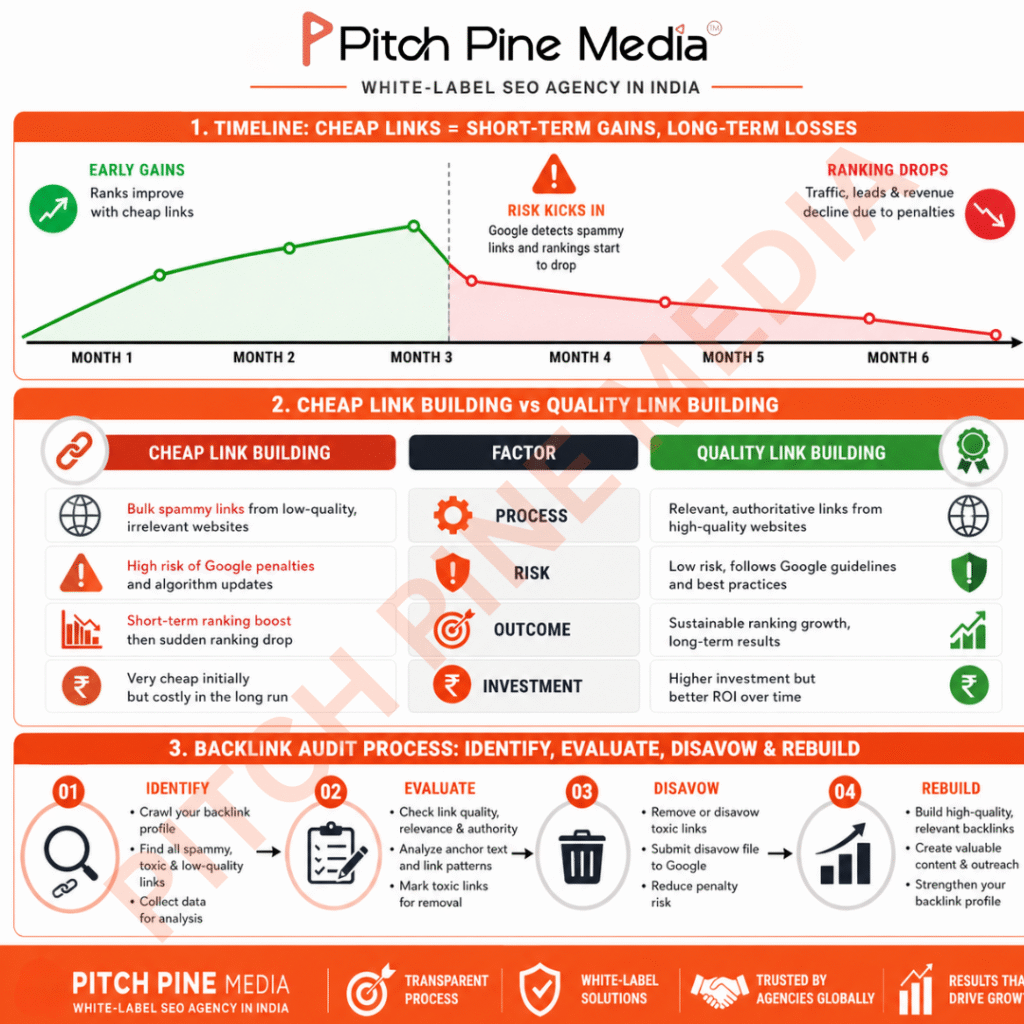
Cheap links feel like a shortcut when you’re under pressure to deliver results.
Lower cost per link. Faster turnaround. Easy margins.
Many agencies try this at some point, especially when working with a white-label SEO agency in India to scale delivery.
The problem is, the real cost doesn’t show up immediately. It shows up later.
The real problem: short-term wins, long-term damage
In the first couple of months, cheap links can look fine.
You might see:
- Slight ranking improvements
- Faster link acquisition
- Happy clients because activity is visible
But by month four or five, things start to shift.
Rankings stall. Sometimes they drop. Progress becomes inconsistent.
That’s when agencies realize the issue isn’t volume. It’s quality and context.
What cheap links usually look like behind the scenes
Not all low-cost links are bad, but most follow similar patterns.
They come from:
- Sites built purely for link selling
- Irrelevant niches
- Thin or recycled content
- Pages overloaded with outbound links
On paper, they might still show decent metrics.
But those metrics don’t reflect real authority.
This is where many teams that outsource SEO services to India providers get caught off guard. The surface looks clean. The foundation isn’t.
The 6-month reality most agencies face
Around the six-month mark, patterns become clearer.
First, ranking volatility increases
Pages that were climbing start fluctuating without a clear reason.
Second, link value plateaus
New links don’t move rankings the way earlier ones did.
Third, recovery becomes harder
Even when you switch to better links, the impact takes longer.
This is where the hidden cost shows up.
You’re not just paying for cheap links. You’re paying to fix their effects.
Why search engines catch up over time
Search engines don’t evaluate links in isolation.
They look at patterns.
If a site builds too many similar, low-context links, it creates a footprint.
It might not trigger a penalty, but it reduces trust.
That’s why early gains don’t last.
A good SEO reseller agency understands this and avoids relying on shortcuts that don’t hold up over time.
The compounding effect on client relationships
The technical impact is one side of the problem.
The client side is worse.
When results slow down, clients don’t see the history behind it. They just see current performance.
You end up explaining why progress has stalled.
That conversation is harder than explaining slower but steady growth from the start.
Where agencies usually go wrong
One mistake is focusing only on cost per link.
It feels logical to compare vendors that way, but it ignores long-term impact.
Another issue is not reviewing link sources properly.
If you don’t look beyond metrics, it’s easy to miss red flags.
A third problem is scaling too quickly with the wrong approach.
When volume increases without quality control, issues multiply faster.
How to evaluate link quality practically
You don’t need a complicated framework.
Start with a few simple checks:
Does the site have real traffic?
Is the content relevant to your niche?
Does the link placement feel natural?
Are there too many outbound links on the page?
If most answers are weak, the link probably won’t hold value long-term.
What to look for in a partner
If you’re choosing a provider, ask direct questions.
Where do the links come from?
How do they ensure relevance?
Can they show examples from past campaigns?
If the answers are vague or focused only on metrics, that’s a warning sign.
At Pitch Pine Media, link building is approached with long-term stability in mind. That means fewer shortcuts and more focus on placements that continue to add value months later.
The smarter approach to scaling links
You don’t need the most expensive links.
But you do need consistency.
A balanced approach works better:
- Mix mid-tier and strong links
- Focus on relevance over raw authority
- Build links gradually instead of in spikes
This creates a natural growth pattern.
It might feel slower at first, but it tends to hold.
The practical takeaway
Cheap links aren’t always a problem immediately.
They become a problem when you rely on them.
The real cost shows up in lost momentum, recovery time, and client trust.
Link-building decisions compound over time. Choosing a white-label SEO agency in India that prioritizes sustainable link quality over short-term cost savings can prevent the setbacks many agencies face after the first few months.
FAQs
How do agencies balance budget constraints with link quality?
Most agencies create a mix of link types. They avoid going too cheap but also don’t rely only on premium placements to keep costs manageable.
Why do cheap links sometimes show early ranking improvements?
They still pass some value initially, especially if the site has low competition. But that value often doesn’t sustain.
How should agencies explain link quality differences to clients?
It helps to connect links to long-term stability. Clients usually understand when you frame it as avoiding future ranking drops.
What reporting challenges come with low-quality links?
Reports may look good in terms of volume, but it becomes harder to explain why rankings aren’t improving consistently.
Can agencies recover from a poor link profile?
Yes, but it takes time. Cleaning up and rebuilding with better links often delays progress compared to doing it right from the start.

