


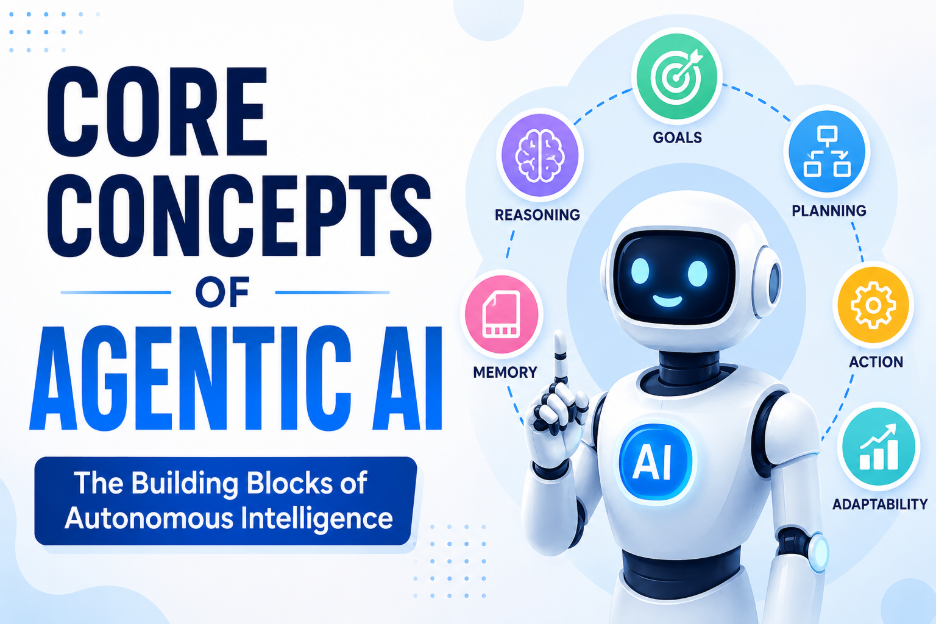
Agentic AI operates through five core concepts: Autonomous Decision-Making, Multi-Step Planning, Memory Management, Tool Integration, and the ReAct Feedback Loop.
Let’s break down the five core concepts that make Agentic AI what it is.
Concept 1: Autonomous Decision-Making
This is where everything begins. An Agentic AI system doesn’t wait for instructions at every turn — it receives a goal and starts making decisions on its own to achieve it. That independence is what makes it fundamentally different from a traditional AI tool.
The agent evaluates the situation, weighs its options, and picks the best course of action — all without you stepping in. The more capable the agent, the better its decisions become over time. This autonomous quality is the defining trait that sets agentic systems apart from every chatbot you’ve used before.
You can also explore: Agentic AI vs Traditional AI
Concept 2: Multi-Step Planning and Reasoning
Executing a ten-step workflow autonomously? That’s where Agentic AI truly shines. Multi-step planning is the ability to take a complex objective and map out a logical sequence of actions to get there.
Here’s how the planning process typically unfolds:
- Goal Interpretation: The agent understands the end objective and identifies what success looks like.
- Task Decomposition: It breaks the goal into smaller, actionable subtasks that can be tackled one by one.
- Sequencing: It arranges those subtasks in the most logical and efficient order before taking the first action.
- Replanning: If conditions change mid-task, the agent adjusts its plan dynamically rather than failing or stopping.
Concept 3: Memory and Context Management
Imagine asking someone to complete a complex project — but they forget everything after each conversation. That would be frustrating and ineffective. Memory solves this problem for Agentic AI systems by giving them continuity across steps and sessions.
There are two layers of memory that work together:
- Short-Term Memory: Keeps track of everything happening within the current task or session, so the agent always knows where it is in the process.
- Long-Term Memory: Stores information externally and retrieves it when needed, allowing the agent to build on past interactions and knowledge over time.
Together, these memory systems allow an agent to behave less like a tool and more like a reliable, context-aware collaborator that remembers what matters.
Concept 4: Tool Use and Integration
An Agentic AI system doesn’t work in isolation — it reaches the world around it. Tool use is the concept that allows agents to connect with external systems, gather real-time data, and take actions beyond generating text.
Here’s what tool integration looks like in practice:
- Web Search: The agent searches the internet to retrieve current, accurate information before responding or acting.
- Code Execution: It writes and runs code in real time to solve problems, automate tasks, or process data on the fly.
- API Calls: It connects to third-party services — CRMs, databases, calendars — to pull or push information as needed.
- File Handling: It reads, writes, and manages files autonomously as part of a larger workflow.
- RAG (Retrieval-Augmented Generation): It retrieves relevant knowledge from a custom knowledge base before generating a response, making outputs far more accurate and grounded.
Also check: What is RAG and Why is it Important?
Concept 5: The Perception and Feedback Loop (ReAct Framework)
This is the concept that ties everything together. The ReAct framework — short for Reason + Act — is the operational loop that most agentic systems run on. It’s elegant, powerful, and absolutely central to how agents improve as they work.
Here’s how the loop works in sequence:
- Perceive: The agent observes its current environment, the task at hand, and any new information available to it.
- Reason: It thinks through the situation and decides on the best next action to take based on its goal.
- Act: It executes that action — whether that’s calling a tool, generating output, or moving to the next subtask.
- Observe: It reviews the result of the action and compares it against the expected outcome.
- Refine: Based on what it observes, it adjusts its reasoning and plans its next move accordingly.
This continuous loop is what makes agentic systems self-correcting and adaptive. They don’t just execute — they learn from each step and get smarter as they go.
Conclusion
The future of artificial intelligence is becoming increasingly autonomous, and Agentic AI sits at the center of that transformation. Unlike traditional systems that simply respond to commands, intelligent agents can pursue goals, make decisions, adapt to changing environments, and continuously improve their performance.
By understanding the core concepts discussed in this guide, you gain valuable insight into how these systems operate and why they are reshaping industries worldwide. Whether you are exploring AI for personal growth, career advancement, or business innovation, building a strong understanding of Agentic AI foundations today will prepare you for the intelligent systems of tomorrow.

