


Summary
Halal certification in Dubai involves demonstrating that a product, service or production system complies with applicable halal requirements and relevant UAE standards. The exact process depends on the type of business, product category, manufacturing arrangements, ingredients, supply chain and certification scheme.
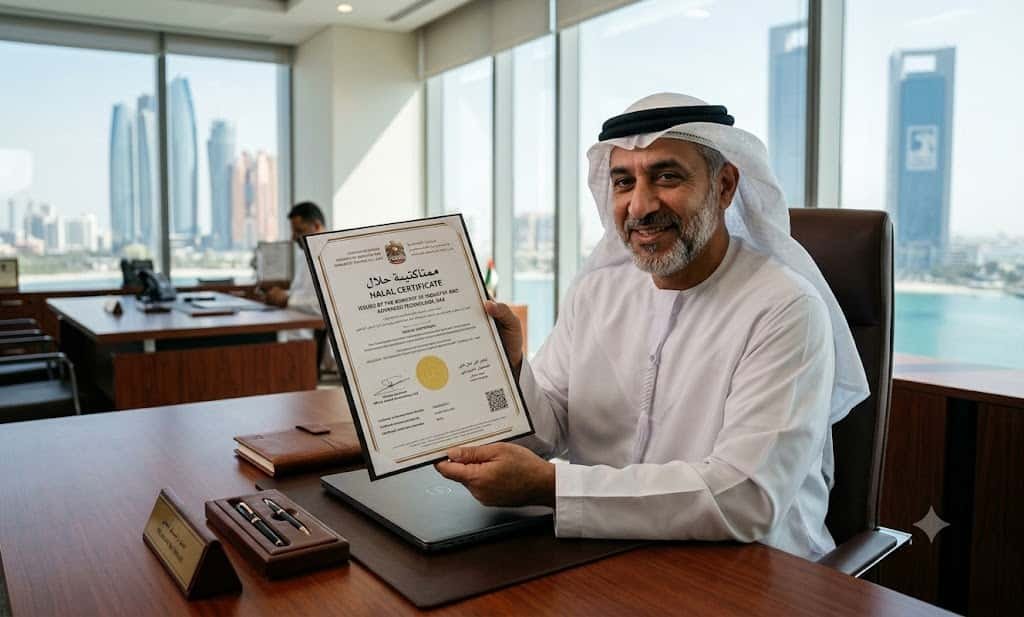
The UAE Ministry of Industry and Advanced Technology (MOIAT) administers the National Halal Mark framework. The National Halal Mark can be granted to a product, service or production system after conformity requirements are verified.
Dubai Municipality also has halal certification and product conformity capabilities through its Dubai Central Laboratory Department. Its published standards include requirements for halal assurance management systems and specific requirements for areas such as slaughterhouses, meat processing and halal cosmetics and personal care products.
Takween Advisory can help businesses understand the relevant certification route, prepare documentation and coordinate the requirements involved in pursuing halal certification.
Overview
Halal certification can be important for businesses that manufacture, import, distribute or sell products marketed as halal.
The certification process is not simply a document submission. Depending on the certification scheme, the assessment can involve reviewing ingredients, production processes, suppliers, hygiene controls, storage arrangements, traceability procedures, laboratory testing and on-site assessment.
The UAE’s halal framework is supported by recognised standards and certification bodies. MOIAT identifies UAE.S 2055-1 for general halal food requirements, UAE.S 2055-2 for halal certification bodies, UAE.S 993 for animal slaughtering requirements and UAE.S 2055-4 for halal cosmetics and personal care products.
Businesses should therefore determine the correct certification requirements before submitting an application.
Quick Answer
Quick Answer: To get halal certified in Dubai, a business generally needs to identify the applicable halal standard, prepare product and company documents, submit an application to an appropriate recognised certification body, complete the required assessment or audit, resolve any non-conformities and obtain the applicable halal certificate or mark.
What Is Halal Certification in Dubai?
Halal certification provides documented assurance that a product, service or production system meets applicable halal requirements.
For eligible businesses, the UAE National Halal Mark provides a recognised conformity framework. MOIAT states that the mark is issued after verification that products conform to approved standards and that the establishment complies with UAE halal requirements.
The certification may cover different categories, including food products, cosmetics, personal care products and other halal-related products or services.
The applicable requirements depend on what the business produces or supplies.
Who May Need Halal Certification?
The requirement depends on the nature of the product and the applicable UAE or Dubai regulatory framework.
Businesses that may need or benefit from halal certification can include:
- Food manufacturers and processors
- Meat and poultry businesses
- Food importers and exporters
- Restaurants and food-related businesses where halal claims or specific requirements apply
- Cosmetics and personal care manufacturers
- Businesses supplying halal products to particular markets
- Manufacturers seeking recognised halal conformity for export
Not every business follows the same certification route. The applicable authority and certification scheme should be identified according to the product and intended market.
Main Halal Certification Requirements in Dubai
A business should first identify the relevant halal standard and certification scope.
Valid Business Licence
The business should have the appropriate commercial or industrial licence for its activity.
MOIAT’s conformity-mark service identifies a valid UAE industry or trade licence as a requirement for relevant national conformity mark applications.
Product Information
The certification body may need detailed information about the products being certified, including product names, formulations, ingredients and manufacturing details.
Ingredient Documentation
Ingredients and raw materials should be traceable and supported by appropriate documentation.
Where an ingredient has a potential halal concern, the business may need supporting evidence, supplier declarations, laboratory testing or halal certificates from recognised sources.
Manufacturing Information
Businesses should be prepared to provide information about production facilities, manufacturing processes, equipment, storage and handling.
Supplier Documentation
Supplier information can be important because halal compliance may extend through the supply chain.
Businesses should maintain appropriate records for raw materials and ingredients so that their origin and status can be verified.
Labelling and Packaging
Product labels should comply with applicable UAE requirements and should not make misleading or unsupported halal claims.
Dubai Municipality’s product certification framework also emphasises conformity with applicable standards and regulations before products subject to mandatory requirements are sold or used.
Halal Certification Audit Process in Dubai
The audit or assessment depends on the certification scheme and product category.
Step 1: Identify the Certification Scope
The business first determines which products, services, facilities or production systems will be included.
This is important because different products can fall under different standards and assessment requirements.
Step 2: Submit the Application
The company submits the application and supporting documents to the relevant certification body.
For National Conformity Marks, MOIAT’s published process includes registering on its digital platform, submitting the application, attaching required documents, completing the applicable assessment and paying the relevant fees.
Step 3: Document Review
The certification body reviews the submitted information.
This can include product specifications, ingredient information, manufacturing processes, supplier documents and existing conformity or laboratory reports.
Step 4: Factory or Facility Assessment
Where required, auditors assess the relevant facility and production processes.
Dubai Municipality’s published halal assurance standard provides a framework covering management-system and operational requirements for organisations supplying halal products or services.
Step 5: Testing and Verification
Depending on the product, laboratory testing may be required.
MOIAT’s national conformity mark service identifies test reports from accredited laboratories as part of the requirements for applicable conformity-mark licensing.
Step 6: Corrective Actions
If the assessment identifies non-conformities, the business may need to submit corrective actions and supporting evidence.
The certification process can take longer if significant issues need to be corrected before certification is granted.
Step 7: Certification Decision
Once the applicable requirements have been satisfied, the certification body makes its certification decision and issues the relevant certificate or authorisation.
How Long Does Halal Certification Take in Dubai?
There is no single timeline that applies to every halal certification application.
A straightforward application with complete documentation and a compliant facility can move more quickly than an application involving multiple products, complex ingredients, laboratory testing or corrective actions.
A practical planning range can be approximately 2–6 weeks, although the actual timeframe can be shorter or longer depending on the certification scope and authority.
For the UAE National Conformity Mark service, MOIAT currently publishes a service time of 6 working days for the relevant national conformity-mark service, but this should not be interpreted as a universal completion time for every halal certification project because assessments, laboratory work and certification-body procedures can vary.
Halal Certification Cost in Dubai
Halal certification costs vary significantly according to the certification body, number of products, facility size, audit duration, laboratory testing and certification scope.
For National Conformity Marks, MOIAT currently publishes fees including technical assessment at AED 2,500 per day per assessor/resident, a three-year National Conformity Mark licence certificate at AED 670, and a conformity certificate fee of AED 2,500 per day per assessor under the listed service. Additional expenses can apply for travel, transportation, accommodation and other assessment-related requirements.
A business’s overall halal certification budget may therefore include:
- Application and Certification Fees: Authority and certification-body dependent
- Technical or Factory Assessment: Based on assessment duration and scope
- Laboratory Testing: Based on required tests and approved laboratory
- Corrective Action or Follow-up Assessment: If applicable
- Additional Travel, Transportation or Related Expenses: If applicable
Important Disclaimer
Important Disclaimer: The cost prices mentioned above are baseline estimates and are subject to market fluctuations, supplier changes, government fee updates and variable logistics fees. Certification bodies may also revise their assessment and certification charges. For the latest and most accurate prices, please contact Takween Advisory for professional guidance and a tailored halal certification cost assessment.
Common Reasons for Halal Certification Delays
Incomplete documentation is one of the most common reasons an application may take longer than expected.
Ingredient information can also create complications if suppliers cannot provide sufficient evidence regarding the halal status of raw materials.
Other potential issues include inadequate traceability, unsuitable storage arrangements, cross-contamination risks, incomplete production records and non-conformities identified during the audit.
Businesses can reduce delays by reviewing their documentation and internal processes before the formal assessment.
How to Prepare for a Halal Audit
Preparation should begin before the certification body conducts its assessment.
Review Ingredients
Create a complete list of ingredients and raw materials used in the products included in the certification scope.
Check whether supporting halal documentation is available for ingredients that require verification.
Review Suppliers
Maintain current supplier information and relevant certificates or declarations.
This helps demonstrate traceability throughout the supply chain.
Review Production Processes
Document the manufacturing process from receipt of raw materials through production, storage and dispatch.
The process should demonstrate appropriate controls to prevent prohibited substances or cross-contamination from affecting halal products.
Review Storage and Handling
Separate and properly identify relevant materials and finished products where required.
Storage and handling procedures should support the integrity of the halal status of the products.
Prepare Employees
Employees involved in procurement, production, quality control, storage and logistics should understand the applicable procedures.
Clear responsibilities can make the audit process more efficient.
What Happens After the Halal Audit?
If the audit identifies no significant non-conformities and all certification requirements are satisfied, the certification body can proceed with the certification decision.
If non-conformities are identified, the business may need to implement corrective actions.
The certification body can then review the evidence and determine whether the requirements have been adequately addressed.
For ongoing certification, businesses should continue maintaining the relevant halal assurance controls rather than treating certification as a one-time exercise.
Halal Certification for Food Products
Food businesses may face detailed requirements relating to ingredients, processing, slaughtering, hygiene, storage and labelling.
The UAE halal framework includes UAE.S 2055-1 for general halal food requirements and UAE.S 993 for animal slaughtering requirements.
Businesses dealing with meat and poultry may therefore have additional requirements compared with businesses dealing with packaged plant-based products.
The correct certification scope should be determined before beginning the application.
Halal Certification for Cosmetics and Personal Care Products
Halal requirements can also apply to cosmetics and personal care products.
MOIAT lists UAE.S 2055-4 as the standard for halal cosmetics and personal care products.
Manufacturers may need to review ingredients, processing aids, manufacturing processes and contamination controls.
Dubai Municipality’s halal assurance standard also identifies specific requirements for halal cosmetics and personal care products.
National Halal Mark vs Halal Certificate
A halal certificate and the UAE National Halal Mark should not automatically be treated as identical documents.
A halal certificate may be issued through an appropriately recognised certification body for a particular product or scope, while the National Halal Mark is a UAE conformity mark administered under the national framework.
MOIAT states that the National Halal Mark is optional and can be granted to qualified products, services or production systems that meet the applicable requirements.
Businesses should determine which certification or mark is required for their intended market, product and regulatory situation.
How Takween Advisory Can Help
Takween Advisory can help businesses understand the halal certification process and prepare for the applicable requirements in Dubai and the UAE.
Support can include identifying the relevant certification scope, reviewing documentation, organising product and company information, understanding audit requirements and coordinating the certification process.
Businesses looking for a halal certification service Dubai can benefit from professional guidance when they are unsure which certification route applies to their products or when documentation needs to be prepared before an audit.
The goal is to help businesses approach certification with a clear understanding of the requirements, expected process and potential costs.
Common Mistakes to Avoid
Businesses should avoid submitting an application without first confirming the correct certification scope.
They should also avoid relying on outdated supplier certificates or incomplete ingredient information.
Another common issue is failing to review production and storage processes before the audit.
Businesses should also avoid assuming that obtaining a halal certificate automatically satisfies every Dubai or UAE product-registration requirement. Other regulatory registrations or conformity requirements may apply depending on the product category.
Why Halal Certification Matters for Dubai Businesses
Halal certification can provide documented evidence that a product or production system has been assessed against applicable halal requirements.
MOIAT describes the National Halal Mark as a mechanism for demonstrating conformity with UAE halal requirements and supporting the movement of halal products into UAE and international markets.
For businesses targeting Muslim consumers, retailers, distributors or export markets, appropriate halal certification can therefore form part of their regulatory and commercial strategy.
Frequently Asked Questions
Is halal certification mandatory in Dubai?
The requirement depends on the product, activity, applicable regulations and intended market. Not every business is subject to exactly the same halal certification requirement. Businesses should determine the applicable rules for their specific products.
How long does halal certification take in Dubai?
A practical planning range can be around 2–6 weeks for many applications, but the actual timeframe depends on documentation, product complexity, laboratory testing, facility assessment and corrective actions.
What documents are required for halal certification?
Documents can include the business licence, product specifications, ingredient lists, supplier information, manufacturing details, laboratory reports and existing certificates or declarations, depending on the certification scope.
Is a halal audit required?
An assessment or audit may be required depending on the certification scheme. Facility and production-system assessments can be part of the certification process.
Can cosmetics get halal certification in Dubai?
Yes. The UAE halal framework includes specific requirements for halal cosmetics and personal care products under UAE.S 2055-4.
How much does halal certification cost in Dubai?
The cost depends on the certification body, number of products, facility size, audit duration, laboratory testing and certification scope. Government or conformity-mark fees may also apply where relevant.
What is the UAE National Halal Mark?
The National Halal Mark is a UAE conformity mark administered by MOIAT. It can be granted to qualifying products, services or production systems after the applicable requirements have been verified.
Can Takween Advisory help with halal certification?
Yes. Takween Advisory can assist businesses with understanding certification requirements, preparing documentation and coordinating the process with the appropriate certification or regulatory bodies.
Why use a halal certification service Dubai?
A professional halal certification service Dubai can help businesses understand the applicable standards, prepare documents, organise audit requirements and address potential compliance gaps before certification.
Conclusion
Getting halal certified in Dubai requires more than submitting an application. Businesses need to identify the correct certification scope, review ingredients and suppliers, maintain appropriate production controls, prepare supporting documentation and complete the applicable assessment or audit.
The UAE’s halal framework includes recognised standards covering food, certification bodies, slaughtering, cosmetics and personal care products. Dubai Municipality also maintains halal-related standards and certification capabilities for applicable products and services.
Because requirements can vary according to the product and certification route, businesses should confirm the applicable requirements before beginning the process.
If you are planning halal certification in Dubai, Takween Advisory can help you understand the requirements, documentation, audit process, timeline and expected costs through professional halal certification service Dubai support.

