


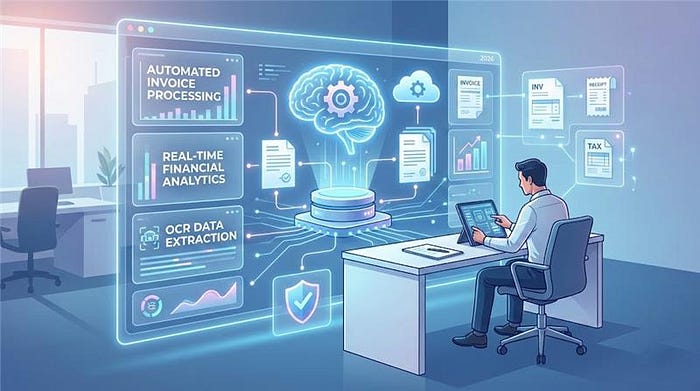
Shift from Manual Work to Intelligent Accounting Automation.
Bookkeeping has always been vital to running business for decades it remained one of the most unpleasant and time-consuming activities in finance. Manual data entry, sorting receipts, processing invoices, and reconciling expenses typically chewed up important hours every week. Even with accounting software most of the process still depended on human work.
In 2026, that reality has evolved substantially.
Artificial intelligence is no longer a future notion in accounting. Finance AI is now firmly incorporated into daily bookkeeping procedures helping organizations process documents faster, eliminate errors and get real-time financial visibility. From automated receipt capture to intelligent invoice processing. AI is revolutionizing how bookkeeping is done not by replacing people but by making their work more efficient and meaningful.
This essay demonstrates how AI is revolutionizing bookkeeping in 2026, the role of accounting automation and why organizations that embrace these technologies are obtaining a big edge.
The End of Traditional Bookkeeping as We Knew It
Traditional bookkeeping relied on manual procedures. Receipts were collected in folders invoices were recorded line by line and expense categorization largely depended on individual judgment.
This approach was slow, error-prone and difficult to scale.
As transaction volumes increased and compliance requirements became stiffer manual bookkeeping started to show its limits. Businesses require faster more dependable ways to manage financial data.
This is when automated bookkeeping stepped in.
AI-powered systems now handle jobs that once required full days. Through Computerized data processing, bookkeeping has shifted from a reactive endeavor to a continuous real-time operation.
How Finance AI Powers Modern Bookkeeping
At the basis of this shift is finance focused artificial intelligence. Unlike basic automation tools new AI systems are meant to comprehend financial data, discover patterns and improve accuracy over time.
Finance AI enables bookkeeping software to:
• Read and analyze invoices and receipts.
• Extract structured data.
• Categorize expenses and Sales intelligently.
• Detect mistakes or duplicates.
• Sync data with accounting platforms like Xero, QuickBooks and Acxite.
These systems do not simply obey predefined rules. They learn from past data, corrections, and user behavior, getting wiser with each transaction.
This learning ability is what separates true accounting automation from older solutions.
Processing of documents Without the Headache
Handling financial documents has always been one of the greatest pain points in bookkeeping. Receipts arrive in different formats, invoices vary by source, and papers can be hazy, partial or inconsistent.
In 2026 paperwork processing is largely automated.
AI systems can now process:
• Scanned receipts.
• Digital invoices.
• PDFs and email attachments.
• Mobile photographs of receipts or can scan directly from phone.
Advanced OCR technology allows these computers to read documents accurately, even when layouts differ. Tools like Receipt Bot use intelligent document recognition to extract critical data points such as line items, totals, tax amounts, vendor names, dates and due dates.
This decreases the need for human verification and avoids the risk of losing crucial documentation.
Invoice Capturing Tools and OCR Technology.
Invoice processing has seen one of the biggest improvements thanks to AI.
latest invoice capture software like Receipt Bot uses advanced OCR models trained specifically on financial documents. Today’s solutions recognize context not just text.
Tools Like Receipt Bot accurately capture invoice data and prepare it for posting in accounting systems. They can also detect missing fields or odd values before errors make their way into financial records.
For companies handling large invoice volumes, this technology has become essential.
Automating Accounts Payable and Expenses.
Beyond data gathering, AI changes entire financial workflow.
With best accounts payable automation software, firms can automate invoice approvals, monitor due dates, and guarantee payments are made accurately. This reduces delays and improves cash flow management.
Expense tracking has also evolved. AI enables:
• Auto Expense & sales classification.
• Real time expense reporting
• Automatic matching of receipts to transactions
Instead of assessing expenditure weeks later, firms now have instant visibility into where money is being spent.
From Manual Entry to Automated Data Entry
One of least efficient portions of accounting has always been human data entry. Reporting takes longer because putting data into spreadsheets or accounting software enhances the possibility of errors.
Most organizations want to automate data entry as much as practicable by 2026.
The following tasks are handled by AI-powered tools:
• Software for entering accounting data.
• Workflows for data entry in accounting.
• Automated data input utilizing Excel connectors.
• Invoices and receipts convey data promptly to accounting systems.
Users just need to examine and approve it instead of entering it.
This maneuver saves time and enhances accuracy while enabling teams to concentrate on other essential operations.
The Rise of the Robot Accountant and Accounting Bots
The thought of a robot accountant previously seemed like science fiction. Today, it’s merely another way to define AI-powered accounting systems.
An accounting bot operates as a digital assistant that performs transactions around the clock. It doesn’t replace accountants it complements them by doing repetitious duties consistently and dependably.
Accounting bots can:
• Process massive numbers of documents.
• Apply classification rules consistently.
• Flag abnormalities for review.
• Keep financial records organized.
Combined with human monitoring, these bots form a balanced system where speed and precision go hand in hand.
Accounting Automation Software in a Connected Ecosystem
One of the reasons AI adoptions has increased is cloud technology. Modern accounting automation software connects readily with cloud accounting systems. This helps financial data to travel easily between systems without duplication or delays.
Accounting automation system finally blends receipt collection, invoice processing, spending monitoring and accounting platforms into a continuous workflow. This reduces manual work and guarantees consistency among records.
For accountants and bookkeepers this reduces errors and greater control over financial data.
Accuracy, Compliance, and Audit Readiness
Accuracy is more crucial in accounting. With digital reporting and increased compliance standards even little errors may produce complications.
AI promotes accuracy by:
•Detecting duplicate entries
•Flagging missing documents
•Identifying odd transactions
•Applying validation criteria automatically
Instead of checking every transaction manually, bookkeepers may focus on exceptions and high-risk items.
This method also boosts audit preparation.
Digital records are organized, traceable, and available year round not just at tax time.
How AI Is Changing the Bookkeeper’s Role
One of the main anxieties regarding AI is job replacement. In accounting, the opposite has occurred.
As accounting technology handles mundane chores, bookkeepers are evolving into more strategic responsibilities. They now spend more time on:
• Financial analysis
• Cash flow planning
• Expense optimization
• Client advisory services
AI reduces the repetitious task, enabling experts to concentrate on insight and decision-making.
Why Small Businesses Are Adopting AI Faster
AI is not only for huge organizations, but small companies also have access to strong accounting tools.
With tools like Receipt Bot, small teams may automate receipt processing, cut accounting expenses and maintain correct records without recruiting extra people.
This has leveled the playing field and enabled small enterprises to operate with more efficiency and confidence.
Challenges and Best Practices for Adoption
While AI delivers evident advantages its deployment still needs strategy.
Businesses should consider:
• Secure data management
• Proper system setup
• Ongoing review and supervision
• Training personnel to operate with automation
AI works best as a collaborator, not a substitute. Human judgment is particularly for complicated financial decisions.
The Future of Bookkeeping Beyond 2026
Looking forward, AI will continue to develop.
Future developments may include:
• Predictive cash flow insights
• Advanced fraud detection
• Deeper banking connections
• Even smarter document recognition
Bookkeeping is expanding beyond record-keeping into real-time financial intelligence.
Final Thoughts!
In 2026 accounting has been changed by AI. What was formerly laborious, sluggish and error prone is now automated, accurate and insightful.
With financial AI, accounting automation software, and intelligent solutions like Receipt Bot organizations can finally leave human data input behind.
AI is not replacing bookkeepers. It’s empowering them — and helping companies develop better, more stable financial foundations.

