


Most agencies don’t switch partners because they want to. They switch because something quietly stopped working.
Reports started feeling vague. Campaigns looked active but weren’t improving. Communication became slower, then reactive.
By the time you notice, damage is already done.
That’s why choosing a white-label PPC management agency in India is less about finding a “good” partner and more about avoiding the wrong one early.
The early signs are subtle, not obvious
Bad partners rarely look bad in the beginning.
They respond fast during sales. They promise structured workflows. They show sample reports that look clean.
The issues show up later.
Campaign changes feel random. There’s no clear testing logic. Reports explain what happened but not why.
Agencies that outsource PPC services India for the first time often miss these signs because everything still looks “active.”
Activity is not the same as direction.
If they can’t explain decisions, that’s your first red flag
Ask a simple question during evaluation. Why did you change bidding strategy on a campaign?
If the answer is vague, you’ll face problems later.
Good white label Google Ads management teams can explain decisions clearly. Not in technical jargon, but in plain reasoning.
What they changed. Why they changed it. What they expect to happen next.
If you don’t get that clarity early, you won’t get it when real issues come up.
The real difference is not skill, it’s structure
Most partners know how to run campaigns.
The difference shows in how they manage work.
Do they follow a process?
Do they review accounts regularly?
Is there a system for testing and optimization?
PPC reseller services teams that rely only on individual skills tend to become inconsistent as workload increases.
Structured teams stay stable even as accounts scale.
That’s what you’re actually evaluating.
Cheap pricing usually hides a workload problem
Low pricing feels attractive, especially when margins are tight.
But ask one question. How many accounts does one manager handle?
If the number is high, quality will drop. Not immediately, but gradually.
Less time per account means fewer optimizations, slower responses, and surface-level work.
Agencies that choose based on price often end up reworking campaigns internally. That cancels any cost savings.
Better to look at workload capacity than pricing alone.
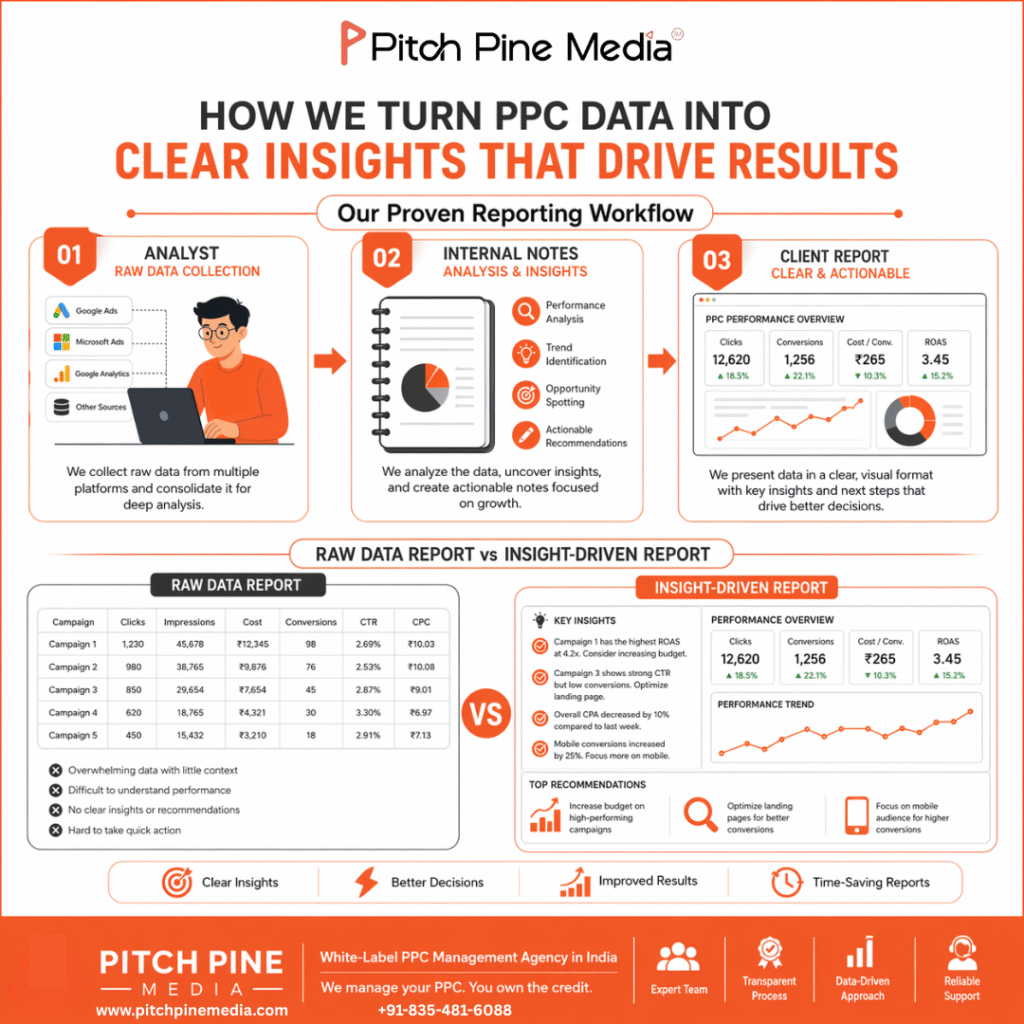
Reporting reveals more than performance
Most agencies look at reports to judge performance.
A better use of reports is to judge thinking.
Are they connecting actions to outcomes?
Do they highlight what’s not working?
Do they suggest next steps?
Weak partners avoid clarity. Strong partners use reporting to show direction.
Teams like Pitch Pine Media usually focus on making reports usable for agencies, not just presentable.
That difference shows up quickly once work starts.
Communication gaps don’t fix themselves
If communication feels slightly off during onboarding, it won’t improve later.
Slow replies. Partial answers. Missed details.
These are early indicators.
Time zones are not the issue. Process is.
Clear communication includes:
- Defined update frequency
- Clear escalation path
- Consistent point of contact
Without this, even good execution becomes hard to manage.
The mistake of not checking how they handle problems
Every PPC account runs into issues.
Performance drops. Costs increase. Campaigns stop converting.
The real test is how the partner reacts.
Ask them directly. What do you do when an account underperforms?
If the answer is generic, expect delays when real problems happen.
Good PPC reseller services teams have a response process. Review, diagnose, adjust, communicate.
That sequence matters more than initial setup.
Why agencies overlook internal alignment before choosing a partner
Sometimes the problem is not the partner. It’s the agency.
If your internal expectations are unclear, even a strong partner will struggle.
Before choosing anyone, define:
- What success looks like
- How often clients expect updates
- What level of detail you need
Without this, you’ll keep switching partners without solving the root issue.
What a reliable partner looks like in practice
You don’t have to chase updates.
You don’t have to decode reports.
You don’t have to double-check every campaign change.
Work feels steady. Communication feels clear. Decisions make sense.
That’s usually the sign you’ve chosen well.
If you’re mapping this into your service stack, it makes sense to connect this to our Google Ads service page. It shows how structured execution works in practice. You can also connect this to our SEO service page if you’re managing integrated campaigns.
Choosing a white-label PPC management agency in India
Most bad partnerships don’t fail loudly. They fail slowly.
Choosing the right white-label PPC management agency in India is about spotting weak signals early and prioritizing structure over promises.
If the process is strong, performance usually follows.
If the process is weak, no amount of time will fix it.
FAQs
1. How do I know if a higher-priced partner will actually improve my margins?
Look at efficiency, not cost. If they reduce internal workload and improve client retention, margins increase even with higher fees.
2. What’s the best way to test communication before committing long-term?
Pay attention during the sales and onboarding phase. Response time, clarity, and detail usually reflect how future communication will be.
3. How long should I wait before judging performance after switching partners?
Give it at least one full optimization cycle. Early weeks are often focused on fixing existing issues, not immediate results.
4. What’s the biggest trust issue when working with a white-label PPC partner?
Lack of transparency. If decisions are not explained clearly, it becomes hard to trust the process.
5. How do I ensure the partner can handle growth as I scale clients?
Ask about team structure and capacity. Scaling works when workload is distributed, not when one person handles everything.

