


Imagine applying for an AI engineering role in 2026. You have machine learning knowledge, understand Python, and have built a few AI projects. But so have thousands of other candidates.
What separates the engineers getting hired from everyone else?
The answer lies in the skills that companies need right now. As AI systems become more powerful and capable, employers are shifting their focus toward engineers who can build intelligent applications, deploy AI at scale, and solve real-world business challenges.
If you’re looking to stay competitive in the AI industry, understanding these high-demand skills isn’t just helpful—it’s essential. Let’s explore the AI engineering skills that are shaping the future of the profession in 2026.
LLM Development and Fine-Tuning
Every serious AI engineering role today revolves around large language models in some form. Whether it’s adapting a foundation model for a specific industry, reducing hallucinations, or improving response quality, LLM fine-tuning is the skill that opens the most doors.
Engineers who understand how to work with models like GPT, Claude, Gemini, or open-source alternatives like Mistral and LLaMA have an immediate advantage. Fine-tuning requires a solid grasp of training data curation, parameter-efficient techniques like LoRA, and evaluation frameworks.
This skill forms the foundation on which every other in-demand skill is built.
Agentic AI System Design Is the Hottest Skill Right Now
Here’s where things get exciting. Agentic AI engineering is not just a trending buzzword — it represents a fundamental shift in how AI systems are built and deployed. Instead of models that simply respond to a prompt, agentic systems can plan, reason, use tools, and complete complex multi-step tasks with minimal human intervention.
That level of automation is what enterprises are investing heavily right now, and they need engineers who know how to design and build these systems responsibly.
Agentic AI engineering sits at the intersection of LLMs, orchestration frameworks, and tool use — making it one of the most comprehensive and valuable skills you can develop in 2026
Retrieval Augmented Generation
Here’s why this skill is non-negotiable right now:
- Enterprise adoption is exploding: Companies are building internal knowledge assistants, legal research tools, and customer support systems that all rely on retrieval augmented generation pipelines.
- RAG eliminates the knowledge cutoff problem: Models trained on old data can now access current, relevant information at query time.
- It reduces hallucinations significantly — Grounding responses in retrieved facts keeps outputs reliable and verifiable.
- Vector database proficiency comes with it: Mastering RAG means you also get fluent with tools like Pinecone, Weaviate, and Chroma — skills that are in demand on their own.
- It’s a baseline expectation: Many AI engineering job descriptions now list RAG experience as a required skill, not a bonus.
If you want to build AI systems that businesses trust, retrieval augmented generation is the skill that gets you there.
MLOps and Model Deployment
You can build the most sophisticated AI model in the world, but if it can’t run reliably in production, then it is just a waste of time. MLOps — the practice of deploying, monitoring, and maintaining AI models in real-world environments — is what bridges the gap between a great idea and a working product.
Engineers who understand CI/CD pipelines for machine learning, model versioning, performance monitoring, and cloud infrastructure are incredibly valuable. Platforms like AWS SageMaker, Google Vertex AI, and Azure ML are now standard parts of the AI engineering toolkit.
MLOps is the unglamorous skill that quietly makes or breaks AI projects, and smart engineers know it’s worth mastering.
Prompt Engineering and AI Orchestration
A lot of people dismiss prompt engineering as something that doesn’t require real technical depth. Those people are wrong.
Effective prompt engineering — especially in agentic and multi-model systems — is a nuanced skill that directly impacts the quality, reliability, and efficiency of AI outputs.
Beyond individual prompts, AI orchestration using frameworks like LangChain or LlamaIndex allows engineers to chain multiple AI components, manage memory, and coordinate tool use across complex workflows. This is especially critical in Agentic AI engineering, where a single agent might need to call different tools, retrieve context, and maintain task continuity across multiple steps.
Model Context Protocol
If you haven’t heard of the model context protocol yet, it’s time to take notes. The model context protocol, a standardized framework created by Anthropic, defines how AI models interact with external tools, APIs, databases, and services. Think of it as a universal language, which makes AI integrations clean, scalable, and interoperable.
Engineers who understand the model context protocol can build AI systems that interact seamlessly with file systems, web browsers, code interpreters, and third-party services — without messy, one-off integrations. This is the skill that separates engineers who build proof-of-concept demos from those who ship robust, production-grade AI products.
The Fastest Way to Build All These Skills Together
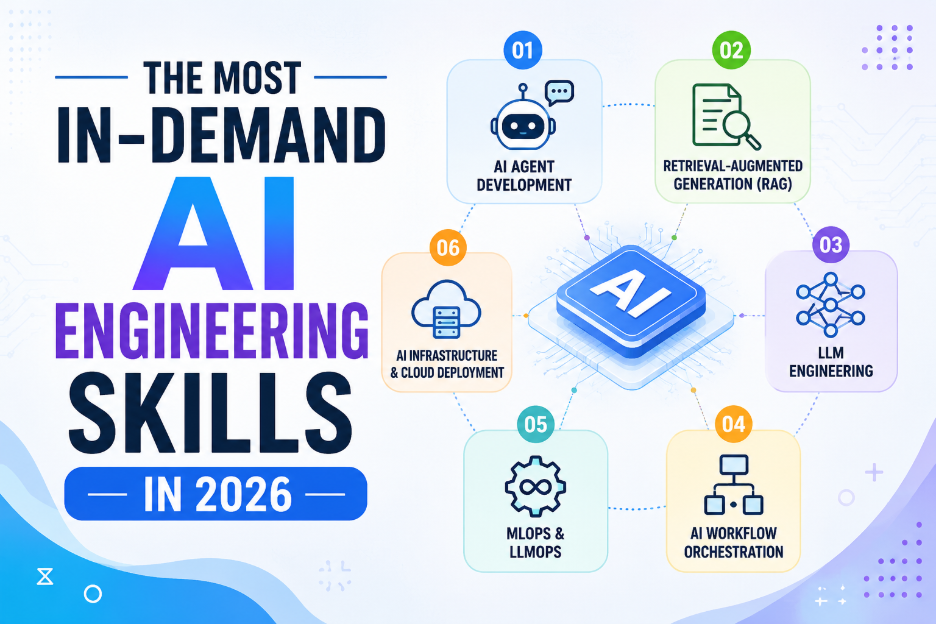
Here’s the challenge — these six skills don’t exist in isolation. They work best when you understand how they connect and complement each other. Trying to learn them one by one through scattered resources is slow, inefficient, and often leaves you with gaps that hurt you in real projects.
A focused Agentic AI engineering course that covers LLMs, RAG, agentic system design, and MCP in an integrated, project-based format is the most efficient path forward.
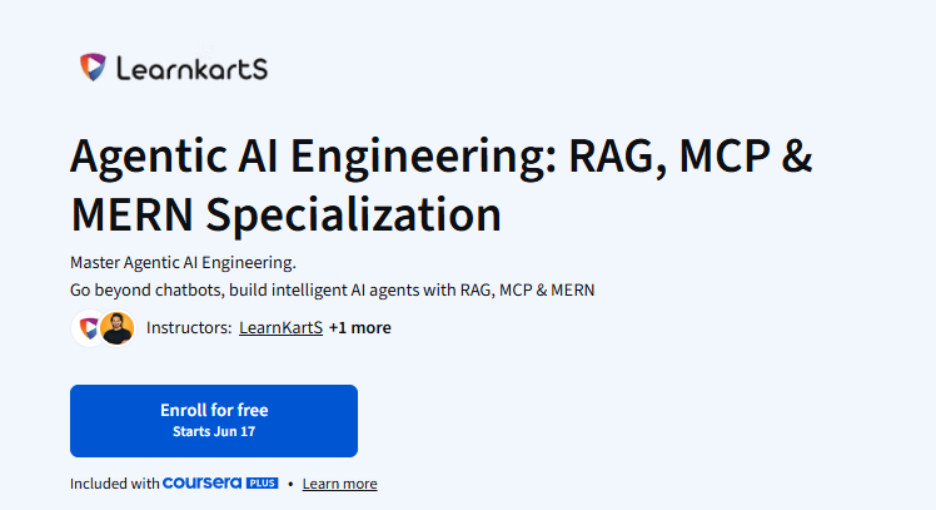
Programs like the Agentic AI Engineering: RAG, MCP & MERN specialization on Coursera are built around exactly this philosophy. A well-structured Agentic AI engineering course doesn’t just teach theory — it puts you through real engineering challenges that mirror what professional teams are building right now.
Your Next Move
The AI engineering market in 2026 is rewarding specialists — engineers who go deep on the skills that matter most rather than spreading themselves thin. The six skills covered in this article represent the clearest path to relevance, employability, and long-term career growth in AI.
The question isn’t whether these skills are worth learning. The question is how quickly you’re willing to start.

