


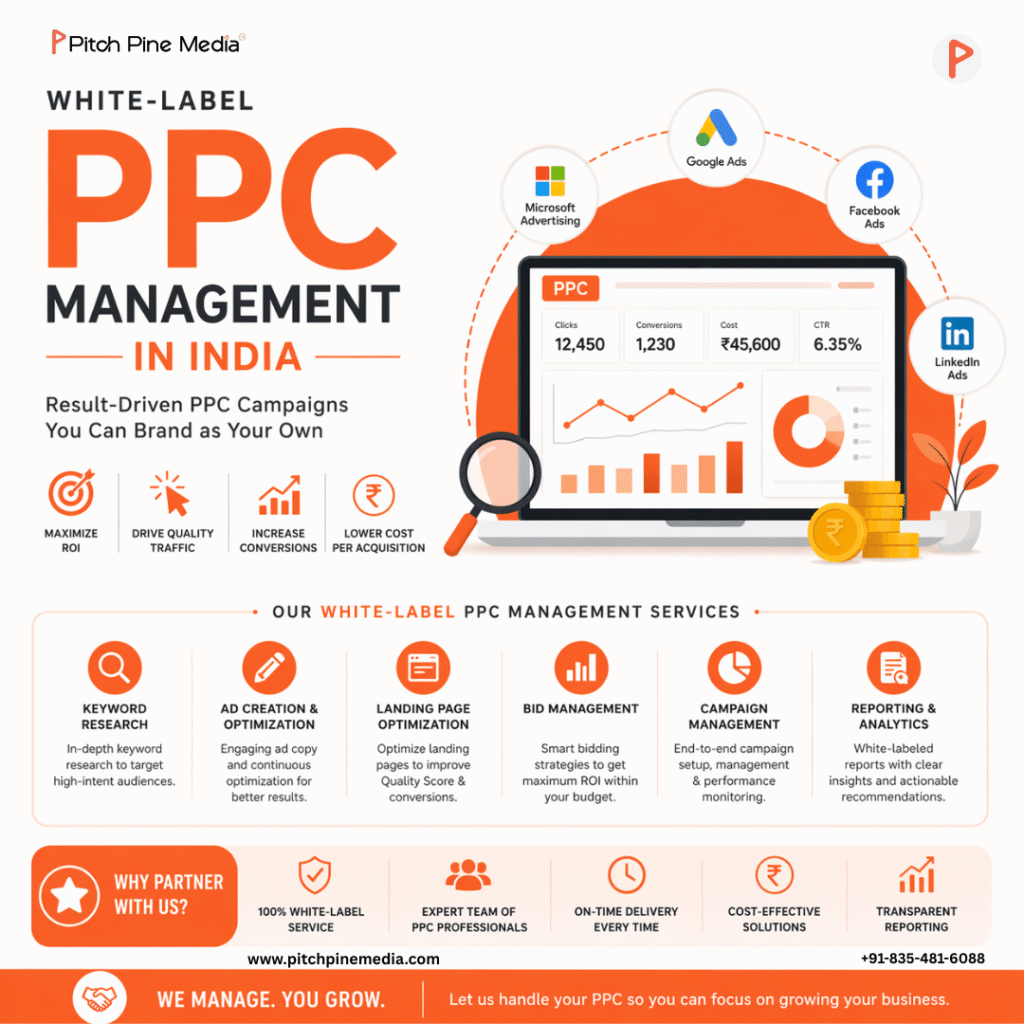
White-label PPC support by Pitch Pine Media.
The problem isn’t that outsourcing fails immediately.
It’s that it works first.
Campaigns stabilize. Reports look clean. Clients don’t complain.
Then slowly, things stop improving.
That’s where most agencies get caught off guard.
The “maintenance mode” trap
After onboarding, most campaigns enter a stable phase.
Nothing dramatic happens. Performance holds steady.
Agencies assume this is a good sign.
But stability without growth is a warning.
Many outsourced teams shift into maintenance mode once campaigns are running smoothly.
Basic optimizations continue. Major testing slows down.
The account is being managed, but not pushed.
Agencies using white-label PPC management in India often notice this phase but misinterpret it as consistency instead of stagnation.
Internal visibility drops faster than expected
When PPC is handled in-house, visibility is constant.
You see changes, test results, and performance shifts in real time.
With outsourcing, visibility becomes report-driven.
You see outcomes, not processes.
Over time, this creates a gap.
The agency knows what is happening, but not why it’s happening.
This becomes a problem when performance dips.
Because now you’re reacting without full context.
This is one of the early signs that control is slipping.
Clients start asking different questions
At the beginning, clients focus on results.
Clicks, leads, conversions.
As campaigns mature, their questions change.
What’s the next growth opportunity? Why aren’t results improving? What’s being tested?
If your partner isn’t actively driving these conversations, the agency has to.
And if the agency isn’t deeply involved in campaign decisions anymore, those answers become harder to give.
This is where PPC campaign management needs to move beyond execution into strategic direction.
Without that shift, client confidence starts dropping.
Delays don’t look serious until they compound
A one-day delay doesn’t feel like a problem.
A missed optimization window doesn’t seem critical.
But repeated delays across multiple campaigns create a pattern.
Budget is not reallocated quickly. Underperforming segments stay active longer.
Opportunities are missed quietly.
This is not a dramatic failure.
It’s gradual inefficiency.
And because it builds slowly, agencies often realize it too late.
Teams working with Pitch Pine Media often experience tighter turnaround cycles, which reduces this issue, but the risk exists in any outsourced structure.
Cost savings start conflicting with performance
At the start, outsourcing reduces operational costs.
That’s the primary motivation.
But when performance stops improving, the focus shifts.
Clients don’t care about your cost structure. They care about results.
If campaigns plateau, conversations become harder.
The agency spends more time explaining than scaling.
This creates pressure on margins.
Because the value perception drops even if the cost remains low.
This is where white-label PPC services need to be evaluated based on output, not pricing.
Communication becomes routine instead of useful
In the beginning, communication is detailed.
Discussions are frequent. Feedback is handled quickly.
Over time, it becomes structured.
Weekly reports. Scheduled updates.
Less discussion, more reporting.
The problem is not lack of communication.
It’s lack of useful communication.
Clients expect insights, not just updates.
If communication doesn’t evolve with campaign maturity, it loses impact.
Agencies working with Pitch Pine Media often maintain strategic discussions alongside reporting, which helps avoid this shift.
The dependency problem shows up late
This is the part most agencies don’t anticipate.
After months of outsourcing, internal teams become less involved.
They stop tracking campaign logic closely.
Everything runs through the partner.
When performance issues appear, stepping back in becomes difficult.
The agency doesn’t have full context anymore.
Switching partners or fixing issues takes longer than expected.
This dependency builds quietly and becomes visible only when something goes wrong.
Agencies don’t fail because outsourcing PPC is ineffective.
They fail because early success hides long-term risks.
Maintenance mode replaces growth. Visibility drops. Communication loses depth.
Small inefficiencies build into bigger problems.
By the time agencies react, performance has already been affected.
Working with experienced partners like Pitch Pine Media reduces many of these risks, but success still depends on how actively the agency stays involved.
Because outsourcing doesn’t remove responsibility.
It just changes how close you are to it.
FAQ
1. Why do PPC campaigns stop improving after outsourcing?
Because many accounts shift into maintenance mode where optimization continues but aggressive growth strategies slow down.
2. How can agencies maintain visibility after outsourcing PPC?
By reviewing campaigns regularly and not relying only on reports for insights.
3. What is the biggest reason agencies lose clients after outsourcing?
Lack of strategic direction and unclear communication during performance plateaus.
4. Are small delays in optimization really a problem?
Yes, when repeated over time, they reduce efficiency and impact overall campaign performance.
5. How can agencies avoid dependency on PPC partners?
By staying involved in strategy and maintaining internal understanding of campaign decisions.

