


Most agencies love SOPs.
They feel structured. Predictable. Scalable.
You document a process once, hand it to the team, and expect consistent output.
That’s the theory.
But if you’ve worked with a white-label SEO agency in India, you’ve probably seen where this breaks.
The SOP exists.
The work still feels inconsistent.
The Real Problem: SEO Doesn’t Stay Static
SOPs work best in stable environments.
SEO isn’t one.
Search intent shifts. Competitors change direction. Algorithms evolve.
A process that worked last month might not work today.
But SOPs don’t adapt on their own.
They keep pushing the same steps, even when the context changes.
That’s where the gap starts.
Where SOPs Actually Fail
It’s not that SOPs are useless.
They just get over-relied on.
Common failure points:
- Following steps without questioning relevance
- Applying the same structure across different industries
- Treating content, links, and technical fixes as isolated tasks
When agencies outsource SEO services India teams execute, rigid SOPs often create mechanical work.
Technically correct.
Strategically weak.
The Illusion of Consistency
SOPs give a sense of control.
Everything looks organized.
But consistency in process doesn’t always mean consistency in results.
Two clients can follow the same checklist and get completely different outcomes.
Because SEO isn’t just about doing tasks.
It’s about deciding what matters most right now.
What High-Performing Teams Do Instead
They use SOPs as a base, not a rulebook.
The process guides them.
But decisions adjust based on context.
For example:
- Keyword research isn’t just pulling data, it’s filtering intent
- Content planning isn’t just volume, it’s prioritization
- Link building isn’t just acquisition, it’s relevance
This shift from execution to judgment is what makes the difference.
And it’s often missing in basic white label SEO services setups.
The Role of Decision-Making in SEO
If you look closely, most SEO outcomes come down to decisions.
Not tasks.
Decisions like:
- Which pages to prioritize
- What to fix first on a site
- When to update vs create new content
SOPs don’t handle these well.
They assume a fixed path.
But real campaigns need flexibility.
That’s why a good SEO reseller agency focuses on training thinking, not just following steps.
The Scaling Challenge
This becomes more obvious when you scale.
At 5 clients, manual oversight works.
At 30 or 50, it doesn’t.
If your system depends only on SOPs, you start seeing:
- Repetitive outputs
- Slower adjustments
- Missed opportunities
Because the system isn’t built for variation.
It’s built for repetition.
What Actually Works at Scale
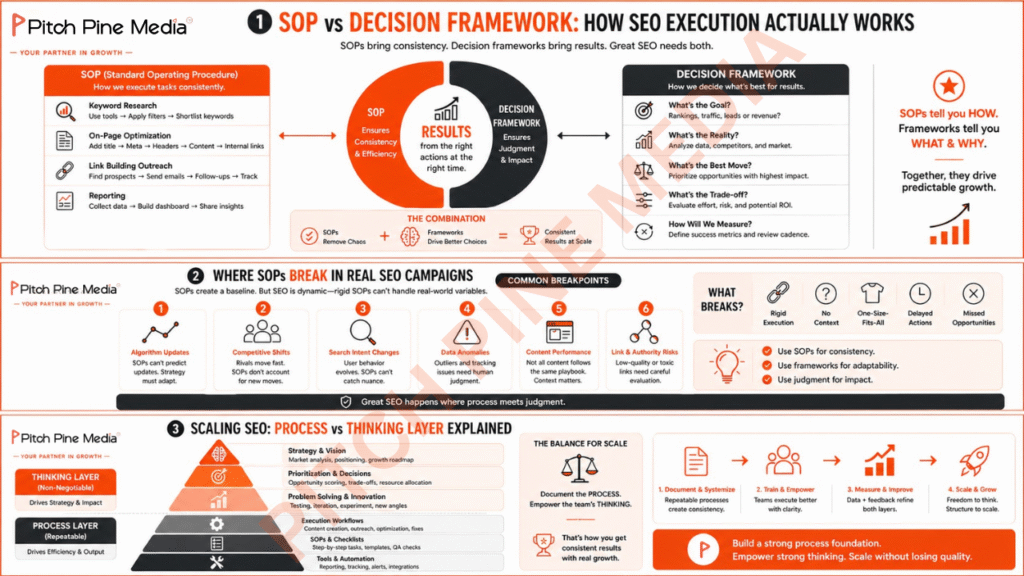
You need two layers.
First layer: structured processes for consistency.
Second layer: decision-making frameworks for flexibility.
That means:
- SOPs define how to execute
- Frameworks define how to think
For example, instead of a fixed content SOP, you use a prioritization model:
- Impact potential
- Competition level
- Business value
This allows teams to adapt without losing structure.
The Common Mistake Agencies Make
They try to fix poor results by adding more SOPs.
More documents. More steps. More rules.
But complexity doesn’t solve the problem.
It usually makes execution slower.
The real fix is clarity.
Clear priorities.
Clear ownership.
Clear decision points.
What to Look for in a Partner
If you’re evaluating a white-label SEO agency in India, don’t just ask for SOPs.
Ask how they handle variation.
Questions that matter:
- How do you adjust strategy across different niches?
- What happens when a tactic stops working?
- How do you prioritize tasks when everything seems important?
You want a team that can think, not just follow.
How Pitch Pine Media Approaches This
At Pitch Pine Media, SOPs are just the starting point.
The real focus is on execution quality.
That means:
- Teams are trained to question and adapt
- Strategy evolves based on performance, not fixed plans
- Work is reviewed through outcomes, not just completion
So you get consistency without rigidity.
And that’s what allows scaling without losing effectiveness.
The Insight Most Agencies Learn Late
SOPs don’t fail because they’re wrong.
They fail because they’re incomplete.
They handle the “how.”
But SEO success depends just as much on the “what” and “why.”
Without that layer, execution becomes routine.
And routine rarely wins in competitive search spaces.
Working with a white-label SEO agency in India gives you the ability to scale delivery, but real performance comes from how decisions are made within that system.
SOPs help maintain structure.
But it’s the flexibility in execution that drives results.
Get that balance right, and scaling SEO stops feeling like a trade-off between quality and volume.
FAQs
1. How detailed should SOPs be for SEO execution?
Detailed enough to guide execution, but not so rigid that they block adjustments based on real data.
2. Why do some teams follow SOPs perfectly but still underperform?
Because they focus on completing tasks instead of evaluating whether those tasks are still relevant.
3. How can agencies ensure consistency without over-relying on SOPs?
By combining structured processes with decision-making frameworks that allow flexibility.
4. What’s a sign that SOPs are hurting SEO performance?
When outputs look repetitive across clients despite different industries and goals.
5. How does scaling impact SOP effectiveness?
As the number of clients grows, rigid SOPs limit adaptability, making it harder to respond to unique situations.

