


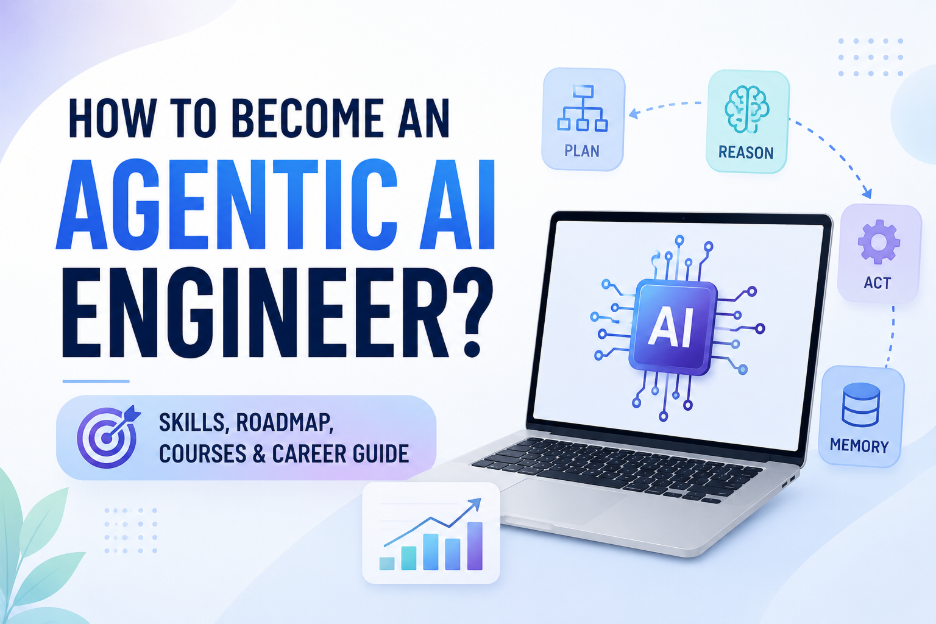
If you’ve been watching the AI space closely, you already know that something big has shifted. AI isn’t just answering questions anymore — it’s making decisions, executing tasks, and operating autonomously across complex workflows.
That’s the world of Agentic AI, and engineers who can build these systems are among the most sought-after professionals in tech right now.
So, how do you actually become one? Let’s break it down, step by step, and get you moving in the right direction.
Core Technical Skills You Need
Before you dive into any program or platform, it’s important to know what foundational skills actually matter. Here’s what you need to develop:
- Python Proficiency: It’s the language of AI development. You need to be comfortable writing clean, efficient, and scalable code.
- Understanding LLMs: Know how large language models work, how they’re prompted, and how they fail.
- Tool use and function calling: Agentic systems rely heavily on structured tool integration. Learn how AI agents interact with APIs and external services.
- Orchestration frameworks: Get hands-on with tools like LangChain, LlamaIndex, CrewAI, or AutoGen. These are the building blocks of most agent architectures.
- Retrieval-Augmented Generation (RAG): Agents need to access external knowledge. Understanding RAG pipelines is non-negotiable.
- Multi-agent system design: Learn how multiple AI agents collaborate, delegate, and communicate in a structured environment.
You don’t need to master all of these at once. But knowing what’s on the map helps you prioritize where to start.
Follow a Structured Learning Path
A clear learning roadmap can accelerate your journey toward becoming an Agentic AI Engineer.
Step 1: Build AI Fundamentals
Start by learning machine learning, deep learning, and NLP concepts. Focus on understanding how AI models are trained and deployed.
Step 2: Learn Generative AI
Study large language models such as GPT-based systems and understand Prompt Engineering techniques.
Step 3: Explore Agent Frameworks
Gain experience with popular agent development frameworks and orchestration tools used in modern AI ecosystems.
Step 4: Create Real Projects
Build autonomous assistants, research agents, workflow automation systems, and task-oriented AI applications.
A structured Agentic AI certification course can help you follow this roadmap efficiently while validating your skills to potential employers.
Build Hands-On Projects to Strengthen Your Portfolio
Employers prefer hands-on experience over theoretical knowledge. That is why project-based learning is important for your professional progress.
Consider building a project such as:
- AI research assistants that gather and summarize information
- Customer service agents that deal with user queries independently.
- Agents for workflow automation of business operations.
- Personal productivity assistants that manage tasks and schedules.
These projects demonstrate your ability to solve real-world problems and showcase your expertise in Agentic AI development.
When recruiters evaluate candidates, a strong portfolio often makes a greater impact than certifications alone.
Choose the Right Courses and Certifications
Choosing the right learning resources can do wonders for your career prospects.
When you are reviewing a course, consider:
- Comprehensive AI and machine learning coverage.
- Projects for practical agent development.
- Techniques for real-world deployment.
- Industry leading certification.
- Updated curriculum to reflect current technologies.
Similarly, an advanced Agentic AI course that emphasizes project-based learning can offer substantial practical experience, extending beyond theoretical concepts.
Thinking about the best course? Here is the best Full Stack Agentic AI course, enroll and start learning!
Gain Experience with Industry Tools and Frameworks
Modern Agentic AI Engineers work with a variety of tools and frameworks. Familiarity with these technologies can make you more competitive in the job market.
Important areas to explore include:
- Agent orchestration frameworks.
- Vector databases.
- Retrieval-Augmented Generation (RAG).
- Workflow automation platforms.
- Cloud-based AI deployment tools.
Understanding how these technologies work together will help you design scalable and efficient AI solutions for enterprise environments.
Career Opportunities for Agentic AI Engineers
The career prospects in this field are expanding rapidly. Organizations are actively seeking professionals who can design and deploy autonomous AI systems.
Potential career roles include:
- Agentic AI Engineer
- AI Solutions Architect
- Generative AI Engineer
- AI Automation Specialist
- Machine Learning Engineer
- AI Product Developer
Companies continue to invest in intelligent automation, and Agentic AI professionals are going to be in high demand and well paid.
Enrolling into a recognized Agentic AI certification course will boost your credibility and help you stand out in the hiring process.
Conclusion
To be an Agentic AI Engineer, you need a combination of AI fundamentals, programming skills, knowledge of large language models, and hands-on project experience. The field is still evolving, so there are great opportunities for professionals willing to learn and adapt.
Begin with a solid foundation in artificial intelligence, then progress to agent frameworks, reasoning systems, memory management, and workflow automation. Spend your time on practical projects that can show off your skills and keep up with emerging technologies.
As autonomous AI systems become a fundamental part of modern business operations, Agentic AI Engineers will be vital in shaping the future of intelligent automation. The sooner you start your learning journey, the more prepared you will be to capitalize on this fast-growing career path.

