


Artificial intelligence (AI) is changing how insurers assess risks, process claims and detect potential fraud. By analysing vehicle records, damage photographs and claim histories, AI can help improve the efficiency of car insurance operations. In India, these applications are becoming increasingly relevant as insurance purchases and claim submissions move online. However, AI still requires reliable data, appropriate oversight and human intervention for complex cases.
How is AI changing car insurance claims in India?
Traditional claims processing involves document verification, vehicle inspections, repair estimates and communication between the policyholder, insurer and workshop. AI can support these activities by processing digital information and identifying details that require further review.
For example, image recognition software can analyse photographs of damaged vehicle parts and help assess visible damage. This information may assist an assessor in preparing a repair estimate. Physical inspections may still be necessary when the damage is extensive or photographs provide insufficient evidence.
AI can also support claims management through:
- Document processing: Extracting information from claim forms, invoices and vehicle documents.
- Damage assessment: Analysing photographs to identify visible damage.
- Claim prioritisation: Directing straightforward claims towards processing and complex cases for further review.
- Fraud detection: Identifying unusual patterns or potentially duplicated claims.
- Customer support: Answering routine questions about claim procedures and documentation.
These applications can reduce repetitive work, but claim decisions must remain consistent with policy terms and available evidence.
How does AI help insurers assess risk?
Risk assessment helps insurers estimate the likelihood and potential cost of future claims. AI systems can analyse historical and current data to identify patterns that may be difficult to detect manually.
Depending on the insurer’s processes and the data available for lawful use, relevant information may include:
- Vehicle make, model, age and specifications.
- Previous claims and repair costs.
- Geographic patterns associated with accidents or theft.
- Replacement-part availability and repair expenses.
- Driving behaviour, where suitable telematics data is collected with appropriate consent.
For instance, repair expenses can vary between vehicles because of differences in parts, labour and installed technology. AI may help insurers recognise these patterns when evaluating potential claim costs.
However, predictions are not guarantees. Incomplete records, outdated information and changing road conditions can affect the accuracy of risk assessments. Insurers must also consider applicable requirements concerning data protection and fair treatment.
What role does AI play in detecting insurance fraud?
AI can help identify potentially suspicious claims by comparing information across documents, repair estimates and available records. A system might flag repeated photographs, inconsistent accident dates or unusually similar invoices for investigation.
Such alerts can help investigation teams identify cases that need closer examination. However, an unusual pattern does not establish that fraud has occurred. Genuine claims can also contain missing documents or discrepancies.
Insurers should verify the available evidence before making decisions. Policyholders should provide accurate information, retain relevant records and respond to reasonable requests for clarification.
Can AI improve claim settlement time?
AI can reduce delays by automating repetitive activities, including document sorting, checking whether information is missing and directing claims to the relevant team. Digital submissions may also allow policyholders to provide photographs without immediately arranging an in-person visit.
Actual settlement time depends on the circumstances of the accident, the completeness of documents, the extent of damage and whether further investigation is necessary.
Policyholders may need to provide the following documents:
| Document | Purpose |
| Insurance policy details | Identifies the relevant policy and cover |
| Vehicle registration certificate (RC) | Provides vehicle registration information |
| Driving licence | Supports driver verification, where required |
| Accident photographs | Records visible vehicle damage |
| Repair estimates and bills | Documents proposed or completed repairs |
| Police or accident records, where applicable | Supports assessment of specific incidents |
Additional documents may be required depending on the claim and policy conditions. Submitting them does not guarantee claim approval or a particular settlement amount.
How can AI and an IDV calculator support vehicle valuation?
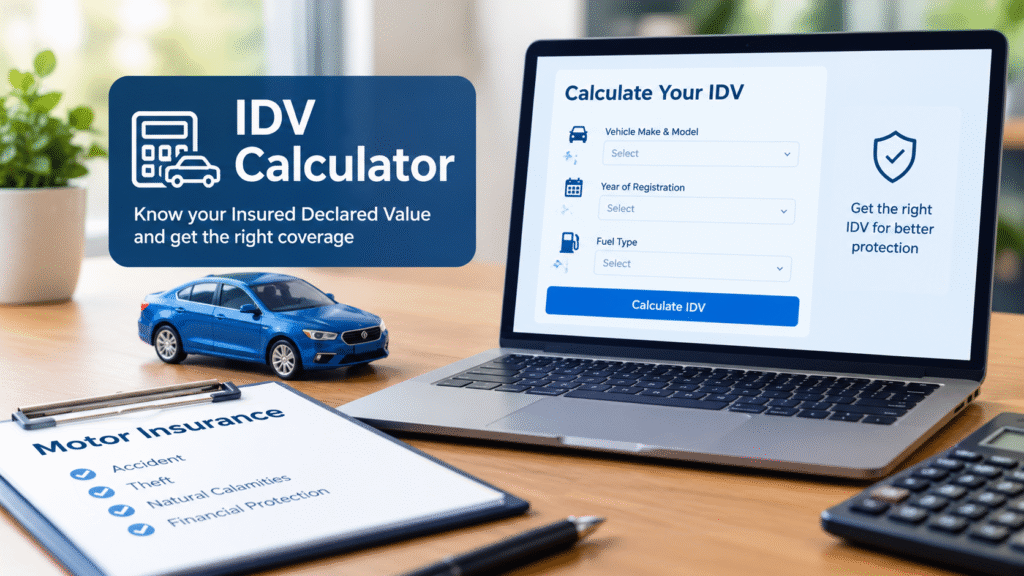
The insured declared value (IDV) represents a vehicle’s insured value for relevant insurance purposes, subject to the insurer’s valuation method and policy terms. It is important when determining premiums for own-damage cover and assessing total-loss claims.
An IDV calculator helps vehicle owners estimate this value using details such as the vehicle’s make, model, age and variant. AI could support valuation by analysing reliable market information, depreciation patterns and vehicle-specific data.
However, an IDV calculator does not guarantee a vehicle’s resale price or the amount payable for every claim. Policy conditions, the applicable valuation method and the circumstances of the loss remain important.
Vehicle owners should enter accurate details and understand how the declared value affects their cover. Choosing an appropriate IDV helps them evaluate the relationship between the insured value, premium and potential protection.
What are the limitations of AI in car insurance?
AI offers useful capabilities, but its effectiveness depends on reliable data and appropriate oversight. Poor photographs, incomplete records or outdated repair-cost information can produce inaccurate assessments.
Key limitations include:
- Data privacy: Personal information must be handled according to applicable requirements.
- Algorithmic bias: Historical data may produce unfair outcomes if systems are not reviewed.
- Limited context: Automated tools may not fully understand unusual accident circumstances.
- Explainability: Policyholders may need clear explanations of assessment decisions.
- Human oversight: Disputed or complicated claims may require expert review.
AI should support evidence-based decisions rather than replace accountability or fair claims assessment.
What should vehicle owners do when an AI-based assessment seems incorrect?
Vehicle owners should provide accurate information when purchasing or renewing a policy, report accidents according to policy requirements and retain relevant photographs and documents.
If a claim assessment appears incorrect, they can ask the insurer to explain its decision and submit additional evidence where appropriate. If the issue remains unresolved, they can use the insurer’s grievance redressal process.
Conclusion
AI is transforming car insurance claims and risk assessment through document processing, damage analysis, fraud detection and vehicle valuation. Although these technologies can improve efficiency, their results depend on data quality, human oversight and policy conditions. An IDV calculator can help owners estimate vehicle value, while accurate documentation and a clear understanding of insurance coverage remain essential.

