


Cloud computing has evolved from a specialized technical skill to a foundational capability across industries. Organizations now build, deploy, and scale applications using distributed cloud infrastructure, making cloud fluency a strategic career asset rather than an optional expertise. Google Cloud Certifications play a crucial role in validating this expertise, equipping professionals with industry-recognized credentials that demonstrate their ability to design, deploy, and manage solutions on modern cloud platforms. Professionals who understand how to navigate cloud ecosystems are better positioned to adapt to technological shifts, automation trends, and evolving enterprise demands.
Future-proofing a career does not mean predicting a single dominant platform. It means developing adaptable competencies that remain relevant even as tools and architectures change. Certifications from Amazon Web Services, Microsoft Azure, and Google Cloud provide structured pathways to build such resilience.
The Shift from Platform Familiarity to Cloud Fluency
Earlier technology roles often revolved around mastering specific tools. Today, cloud roles demand a systems-level understanding of distributed architecture, security principles, automation workflows, and cost optimization strategies. Certifications in AWS, Azure, and Google Cloud validate more than technical steps; they validate problem-solving approaches within scalable infrastructure environments.
Cloud fluency involves recognizing patterns such as event-driven architectures, containerization strategies, identity and access management models, and monitoring frameworks. Each major cloud provider implements these patterns differently, but the underlying architectural logic remains consistent. Professionals who understand this logic gain transferable capability. Click here to compare foundational and professional cloud certification pathways.
Comparative Cloud Ecosystem Overview
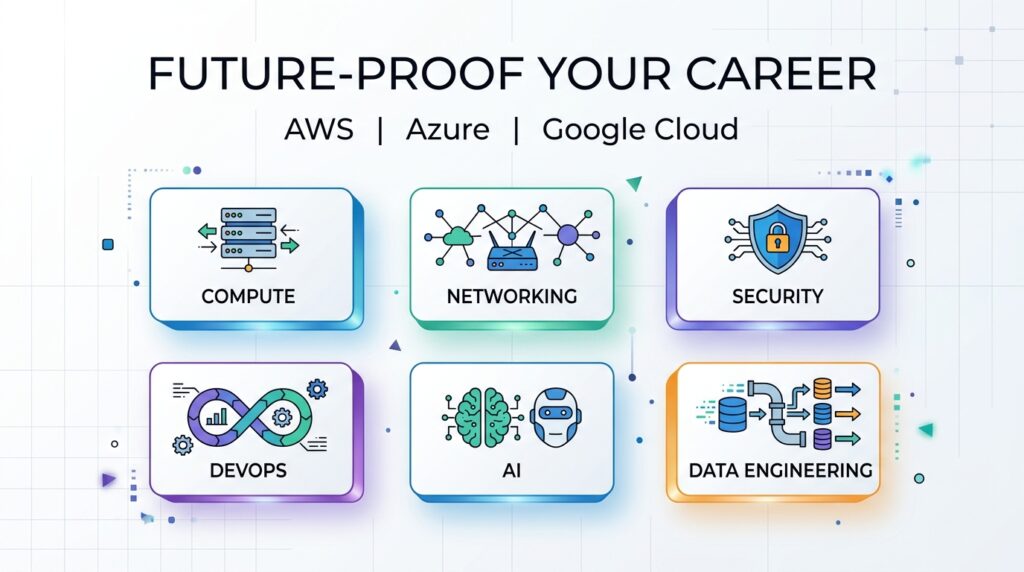
While AWS, Azure, and Google Cloud share core service categories such as compute, storage, networking, and security, their strengths and enterprise positioning differ.
| Cloud Provider | Core Strength | Enterprise Positioning | Common Certification Path |
|---|---|---|---|
| AWS | Broad service maturity and global reach | Strong in startups and large enterprises | Foundational → Associate → Professional |
| Azure | Enterprise integration with Microsoft ecosystem | Strong in hybrid environments | Fundamentals → Associate → Expert |
| Google Cloud | Data analytics and machine learning focus | Strong in data-driven organizations | Foundational → Associate → Professional |
Understanding these distinctions allows professionals to align certification paths with industry demand and organizational context.
Strategic Role Alignment
Future-proofing begins with role clarity. Cloud certifications should reflect professional direction rather than follow market hype. For example, a developer may prioritize certifications emphasizing serverless computing and API integration, while a systems administrator may focus on identity management and hybrid cloud configuration.
Architect-focused professionals benefit from certifications that evaluate solution design, scalability decisions, and risk mitigation. Data-oriented roles may prioritize analytics, big data, and machine learning certifications within Google Cloud or Azure ecosystems. The key is aligning certification investment with long-term professional specialization.
Cross-Platform Skill Portability
One of the strongest arguments for pursuing cloud certifications across multiple providers is skill portability. Concepts such as infrastructure as code, container orchestration, DevOps pipelines, and monitoring principles transcend vendor boundaries.
For instance, understanding Kubernetes within Google Cloud provides transferable knowledge applicable in AWS and Azure contexts. Similarly, identity management principles within Azure Active Directory strengthen general cloud security awareness. Multi-cloud literacy enhances career resilience. Organizations increasingly adopt hybrid and multi-cloud strategies to reduce vendor lock-in and optimize workloads. Professionals capable of navigating multiple environments gain competitive advantage.
Economic and Industry Demand Considerations
Cloud adoption continues expanding across healthcare, finance, manufacturing, retail, and public sectors. Organizations rely on cloud infrastructure for scalability, disaster recovery, analytics, and artificial intelligence integration.
Certifications signal structured knowledge acquisition, which often correlates with improved employability and career mobility. However, long-term security lies not in certification titles alone but in sustained learning and adaptation.
Professionals should evaluate regional industry demand when selecting certification tracks. Some regions show higher Azure adoption in enterprise sectors, while others demonstrate stronger AWS dominance in startup ecosystems. Data-driven career planning enhances long-term stability.
Certification as Structured Learning Framework
Beyond credential value, certifications offer organized learning roadmaps. Cloud platforms evolve rapidly, introducing new services and capabilities. Certification blueprints provide structured coverage of essential concepts, ensuring balanced competency development.
Preparation for cloud certifications often involves practice environments, architectural scenario analysis, and domain-focused study. Platforms such as Cert Empire offer structured practice sessions that mirror certification domains without emphasizing promotional narratives, helping learners map concepts to exam objectives systematically.
However, certification preparation should not replace hands-on experimentation. Real-world labs, sandbox experimentation, and deployment exercises build experiential depth that extends beyond examination requirements.
Automation and Artificial Intelligence Integration
Future cloud ecosystems increasingly integrate automation and artificial intelligence capabilities. Understanding how cloud services support machine learning workflows, automated scaling, and predictive monitoring strengthens long-term relevance.
Professionals who combine foundational cloud certification with knowledge of automation tools and AI services position themselves at the intersection of infrastructure and innovation. This interdisciplinary competence supports adaptability as enterprise requirements evolve.
Cloud certifications increasingly reflect this integration by including monitoring, logging, serverless architecture, and AI-related service coverage.
Risk Mitigation Through Continuous Upskilling
Technological shifts can render specialized knowledge obsolete if professionals fail to adapt. Cloud certifications offer periodic renewal cycles that encourage continuous learning. Recertification processes ensure familiarity with updated security models, compliance standards, and architectural best practices.
Risk mitigation in career planning involves maintaining updated skills while diversifying expertise. For example, combining a cloud certification with cybersecurity knowledge or DevOps specialization reduces dependency on a single role type. Long-term resilience depends on adaptability rather than singular mastery.
Hybrid and Multi-Cloud Reality
Enterprises increasingly adopt hybrid architectures that integrate on-premises infrastructure with cloud services. Azure’s hybrid focus, AWS Outposts, and Google Anthos illustrate this industry trend.
Professionals who understand hybrid deployment patterns can bridge legacy systems with modern cloud-native services. Certifications that include networking, identity federation, and cross-environment monitoring strengthen this capability. Future-proofing, therefore, includes awareness of both cloud-native and hybrid operational contexts.
Skill Depth Versus Credential Accumulation
A common misconception is that accumulating multiple certifications guarantees career security. In reality, depth of understanding matters more than credential count.
Professionals should pursue certifications strategically, ensuring each one contributes to broader architectural or operational expertise. For example, completing an associate-level certification followed by hands-on project experience may provide more value than rapidly collecting unrelated credentials.
Skill depth enhances problem-solving confidence and decision-making capability, which employers value more than certification quantity.
Long-Term Career Impact
Cloud certifications can influence career progression by opening pathways to roles such as cloud engineer, solutions architect, DevOps engineer, or site reliability engineer. However, long-term success depends on applying learned principles within real projects.
Future-proof professionals continuously refine skills, analyze industry trends, and adapt to emerging technologies. Certifications serve as milestones within a larger journey of lifelong learning. Balancing structured study with real-world implementation creates sustainable career growth.
Wrapping Up
Future-proofing a career through AWS, Azure, and Google Cloud certifications requires strategic alignment rather than impulsive credential pursuit. Cloud fluency, cross-platform portability, and lifecycle-based understanding strengthen professional resilience. Certifications provide structured learning frameworks, but long-term stability depends on continuous skill development and practical application. Professionals who combine certification pathways with adaptable thinking and real-world experimentation position themselves to navigate evolving cloud ecosystems confidently and sustainably.
Learn more with Cert Empire You Tube Video.
FAQs
1. Which cloud certification should I pursue first?
Beginners typically start with foundational certifications to understand core services and architecture principles. The best choice depends on industry demand, employer preference, and your intended technical specialization.
2. Are multi-cloud certifications better than focusing on one provider?
Multi-cloud knowledge enhances adaptability, but depth in one platform builds stronger expertise. A balanced approach combining specialization with cross-platform awareness supports long-term career flexibility.
3. Do cloud certifications guarantee higher salaries?
Certifications improve employability and credibility, but compensation depends on experience, problem-solving capability, and market demand. Practical expertise alongside certification strengthens earning potential.
4. How often should cloud professionals update their certifications?
Cloud providers update services frequently. Reviewing certification renewals every few years ensures familiarity with evolving architectures, security standards, and automation tools within each platform.

